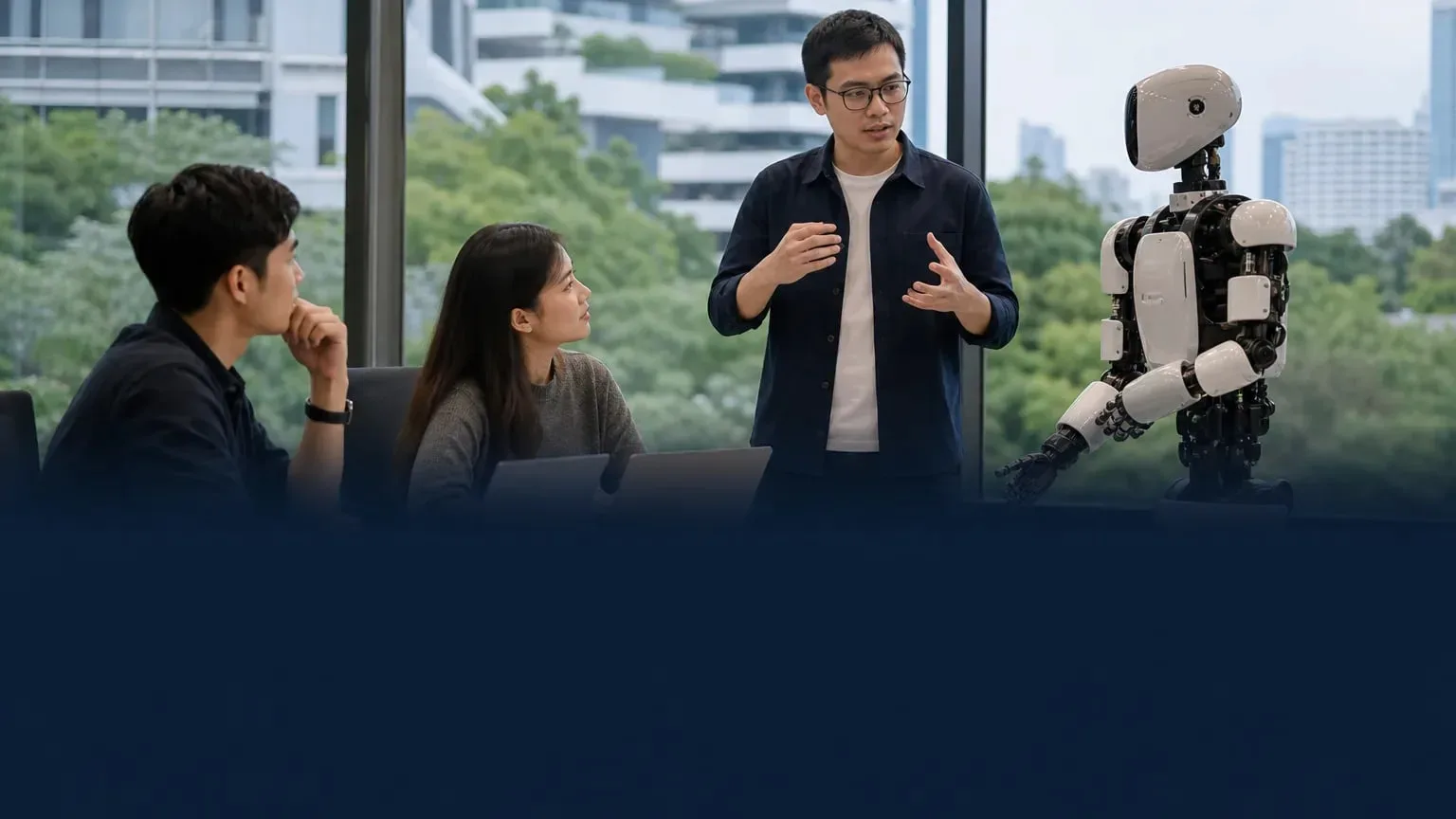
As AI takes on more tasks in higher education, two National University of Singapore educators are making the case that great teaching now depends less on delivering information and more on developing judgement, curiosity and character. Their approach was highlighted at the University Teaching Award Ceremony and Outstanding Educator Award Public Lectures 2026, where Associate Professors Stephen Tay and Robin Loon were recognised for their work.
Key facts
- Associate Professor Stephen Tay teaches in the Department of the Built Environment at the NUS College of Design and Engineering.
- His Contextualised Learning via Enquiring, Answering, and Reflecting framework, known as CLEAR, encourages students to generate questions, answer them with real-world examples and teach peers.
- CLEAR has since been adopted across Singapore and five other countries.
- Associate Professor Robin Loon co-designed GEN2001 Theatre and Community Engagement in the NUS Faculty of Arts and Social Sciences.
- Professor Peter Ho said educators must emphasise critical thinking and character as AI increasingly handles drafting, synthesis and content generation.
What this means for students at NUS and beyond
For students, the shift described by NUS faculty means classroom work is being framed around thinking processes rather than only final answers. In Tay’s CLEAR approach, students are guided to create their own tutorial questions, build answers from real-world examples and then explain those answers to classmates. That changes the student role from receiver to problem-solver and peer teacher.
Loon’s course takes a similar line on the human side of learning. Through role play, process drama and community observation, students are pushed to examine assumptions and test how they respond to everyday ethical situations. The practical goal is not just knowledge retention, but better judgement, openness and self-reflection in situations where AI can supply information but not moral responsibility.
For universities and teachers, the examples suggest a broader teaching challenge: use AI where it helps, but build assessment and classroom design around what AI cannot supply. That includes critical evaluation, resilience and character, all of which were emphasised in the lectures and opening address.
Why does AI change what great teaching looks like?
AI changes the teaching conversation because information is easier to access, and content can be produced quickly. In that setting, the NUS educators argued that the enduring value of teaching lies in helping students judge, question and reflect. Professor Peter Ho said an algorithm can draft, synthesise and generate, but it cannot offer judgement, resilience or character.
That framing places a premium on learning activities that require students to interrogate ideas, connect them to lived experience and form independent conclusions. Tay’s and Loon’s courses are presented as examples of that shift.
How does the CLEAR framework work in class?
CLEAR stands for Contextualised Learning via Enquiring, Answering, and Reflecting. Tay described it as a method in which students are not simply handed tutorial questions. Instead, they are guided to generate the questions themselves, answer them using real-world examples and then teach their peers using those questions and answers.
He developed the framework after students said theoretical equations were difficult to follow. One class used a game to turn urban sustainability challenges into a practical exercise, helping students connect theory to application. According to the article, CLEAR has since spread beyond NUS to schools and educators across Singapore and five other countries.
What does Robin Loon want students to learn?
Robin Loon’s teaching emphasises that education should shape dispositions as much as it transmits knowledge. He argued that skills can be forgotten, while habits of mind and ways of responding to others endure for longer. That belief informs GEN2001 Theatre and Community Engagement, which he co-designed at the NUS Faculty of Arts and Social Sciences.
In the course, students use role play, process drama and observation of communities to examine how they think and behave. A reflection from one student described rethinking how she responded when she saw a pregnant woman on a crowded train. The point, as presented in the lecture, is that classroom experiences can change how students act outside it.
Who was recognised at the NUS award ceremony?
Two faculty members were recognised as exemplary educators at the University Teaching Award Ceremony and Outstanding Educator Award Public Lectures 2026: Associate Professor Stephen Tay and Associate Professor Robin Loon. Tay teaches in the Department of the Built Environment, while Loon is in the Department of English, Linguistics and Theatre Studies.
The event also featured remarks from Professor Peter Ho, Vice Provost (Undergraduate Studies & Technology-Enhanced Learning), who set out the case for greater emphasis on human judgement in the AI era.