
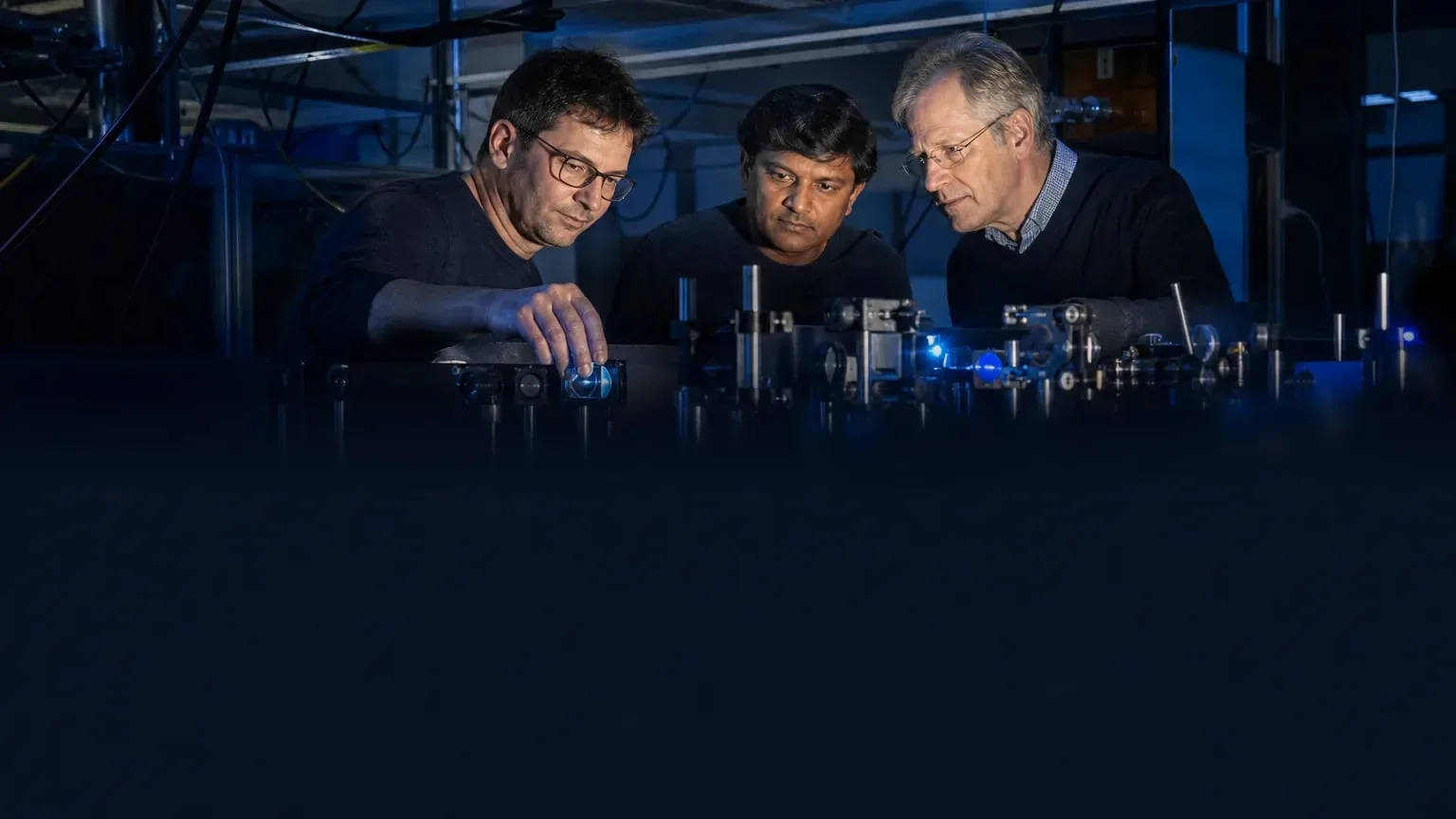
Three Caltech professors — Marco Bernardi, Sujit Datta, and John Sader — have been named fellows of the American Physical Society (APS) for outstanding contributions to physics. The recognition highlights work across quantum materials, soft matter physics, and fluid dynamics, and it places each professor among researchers acknowledged by different APS divisions for distinct areas of study.
Key facts
- Marco Bernardi, Sujit Datta, and John Sader were named APS fellows.
- Bernardi was nominated by the APS Division of Computational Physics.
- Datta was nominated by the APS Division of Soft Matter Physics.
- Sader was recognized by the APS Division of Fluid Dynamics.
- The APS cited each professor’s contributions to research methods and fundamental physics in their fields.
What this means for Caltech students and researchers
The fellowship honors can matter most inside the labs and classrooms where these professors work, because the APS recognition reflects research programs that train students, postdocs, and collaborators. In the cases of Bernardi, Datta, and Sader, the award signals sustained work in computational physics, soft matter, and fluid dynamics that continues to shape research directions at Caltech.
For students and early-career researchers, the practical takeaway is that these are active research groups tied to major physics subfields. Bernardi’s work focuses on first-principles calculations and software for electron interactions and nonequilibrium dynamics; Datta’s group combines experiments, modeling, and simulations in complex fluids and bacterial suspensions; and Sader’s research spans fluid-structure interactions, including the Sader Method used in atomic force microscopy.
Those areas can influence thesis topics, lab rotations, and collaboration opportunities across applied physics, chemical engineering, bioengineering, biophysics, and aerospace engineering.
Who was honored?
Caltech named Marco Bernardi, Sujit Datta, and John Sader as APS fellows for research contributions in three different physics divisions. Bernardi was recognized for computational work on electron interactions and materials behavior, Datta for soft matter physics that bridges biology and complex fluids, and Sader for fluid dynamics and related methods.
What did the APS cite in each case?
For Bernardi, the APS cited pioneering first-principles calculations of electron interactions, transport, and nonequilibrium dynamics in conventional and quantum materials, especially work on electron-phonon interactions and polaron physics, along with novel computational methods and software.
For Datta, the APS cited bridging soft matter physics and biology in realistic settings to advance quantitative understanding of complex fluids and bacterial suspensions in complex environments.
For Sader, the APS cited pioneering contributions to fluid-structure interactions, including the Sader Method for atomic force microscopy, insights into vortex generation by airfoils, and analyses of Boltzmann transport for gaseous and electronic flows.
Why does this recognition matter?
APS fellowship is a peer recognition of work that has already influenced a field, so the announcement underscores the reach of research taking place at Caltech across computation, biology-linked physics, and fluid dynamics. It also shows that the professors’ methods and tools have had effects beyond a single project or lab.
Bernardi said the recognition was meaningful and motivating, and Datta and Sader each pointed to the importance of students, collaborators, and broader research communities in making that work possible.


