
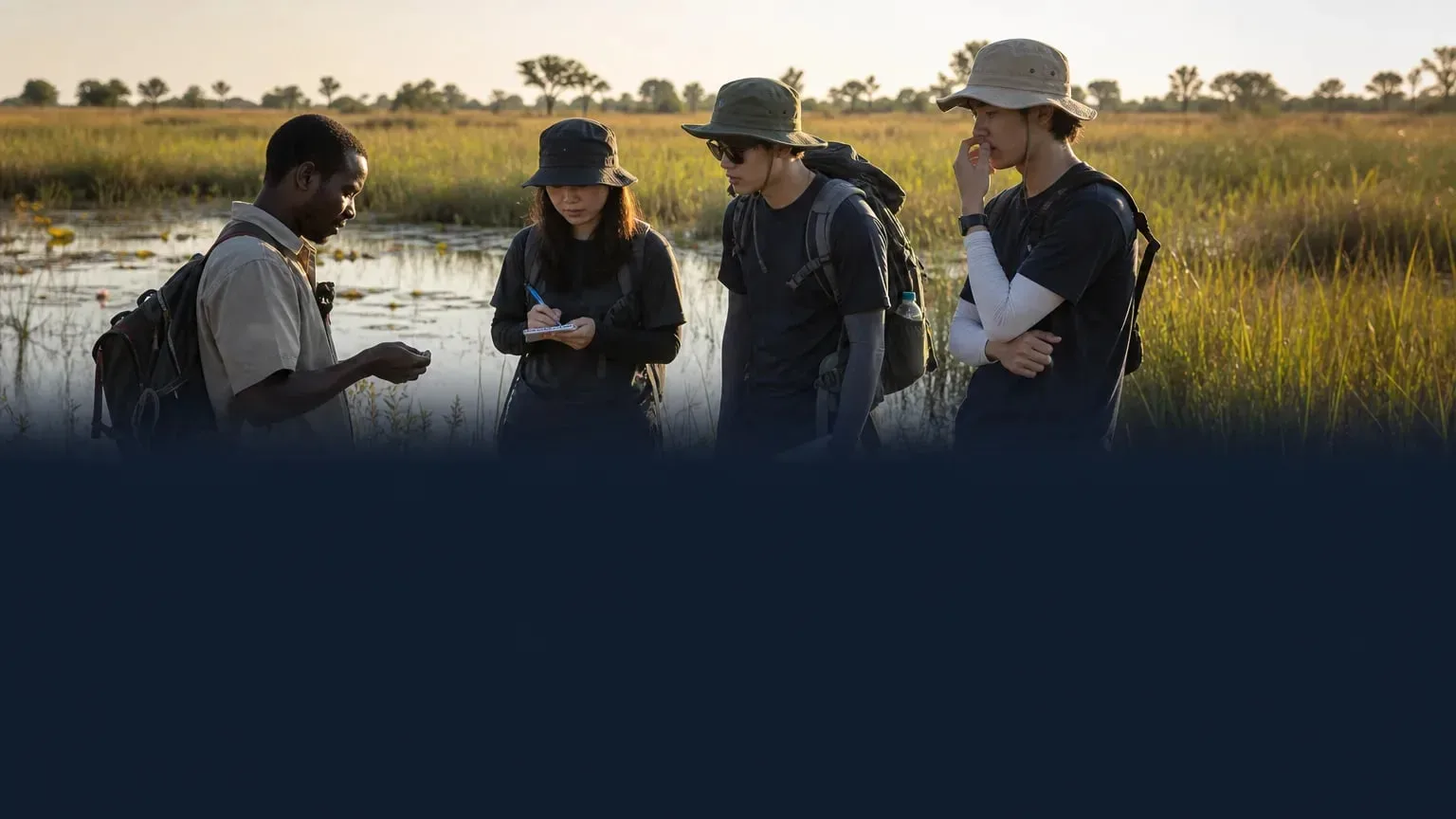
Twenty-four students from NUS College of Alice & Peter Tan (CAPT) spent two weeks in the Botswana towns of Maun and Kasane learning how conservation depends not only on wildlife protection, but also on livelihoods, community participation and local knowledge. The trip showed how environmental decisions in the country’s north are tied to tourism, education and the daily realities of people living alongside the Okavango Delta.
Key facts
- The trip was part of NUS Global Relations Office’s Study Trips for Engagement and EnRichment (STEER) programme.
- Students met community leaders, researchers, educators, local organisations and conservation practitioners.
- The Okavango Delta, a UNESCO World Heritage Site, was a major focus of the visit.
- Students heard about community-based natural resource management, wildlife management and local enterprises in Botswana.
- CAPT’s partnership with Botswana communities and organisations is nearing a 10-year mark in 2027.
What did the Botswana trip mean for CAPT students?
For the students, the trip turned conservation into a practical question about trade-offs. They saw that protecting ecosystems can affect crops, livestock, income and access to natural resources, especially in areas where people and wildlife share the same land. The experience also pushed them to think beyond a simple “protect nature” model and consider how community needs shape conservation outcomes.
The visit gave students direct exposure to organisations and approaches that try to make participation possible, not just symbolic. At Thari-E-Ntsho Storytellers, they saw how storytelling, upcycling and cultural tourism can support income for women, young people and informal workers. At Green Horizons Network, they saw environmental education and a women’s upcycling project that used affordable materials to make bead-making tools. Across the trip, students encountered a recurring idea: conservation is more durable when local people can take part and benefit.
They also heard that some conservation and education initiatives rely on donor funding and are looking at hybrid models that combine tourism, education and community enterprise to strengthen long-term sustainability. That matters for universities and students because it shows how field learning can connect academic study with the real constraints faced by community organisations.
Why was the Okavango Delta such an important stop?
The Okavango Delta offered students a place to see different meanings of the same landscape at once. It is an ecosystem rich in biodiversity, a source of livelihood and tourism, and a place with deep cultural significance for communities who have lived in and around it for generations.
At the Okavango Research Institute, students learned how researchers study the Delta’s ecology, water systems and conservation challenges. They also heard from local guides and educators that environmental knowledge can come from lived experience, including observation of flood patterns, animal behaviour and wildlife movement. That broadened the idea of expertise beyond formal research alone.
How did the trip change the way students thought about wildlife?
One of the strongest messages was that living alongside wildlife involves negotiation, not just admiration. Students were encouraged to question the phrase “human-wildlife conflict,” with a trainer from the Botswana Wildlife Training Institute arguing that calling it conflict can place blame on animals. The framing shifted attention to coexistence and to the pressures that arise when people and animals depend on the same resources.
They also heard about measures used in Botswana to manage those pressures, including fencing, chilli-based deterrents to reduce elephant crop damage, compensation schemes and regulated hunting quotas. Community-based natural resource management was presented as one way to give communities a greater stake in managing and benefiting from natural resources.
What did students take back to Singapore?
Students said the trip prompted them to reflect on how conservation questions connect to home as well. Even though Singapore and Botswana face very different environmental conditions, the central issue remains similar: how can societies protect nature while accounting for the people who live alongside it?
CAPT’s co-lead of the STEER programme, Dr Toh Tai Chong, said the college will mark 10 years of partnership with communities and organisations in Botswana in 2027. That long-running relationship helped make the exchange possible and gave students a chance to learn from a wider set of perspectives than a classroom alone could provide.
Frequently asked questions
What is the STEER programme?
STEER is NUS Global Relations Office’s Study Trips for Engagement and EnRichment programme. It gives students first-hand exposure to diverse sociocultural environments in emerging regions.
Which places in Botswana did the CAPT students visit?
The students spent two weeks in Maun and Kasane, with visits that included the Okavango Delta and the Okavango Research Institute.


