
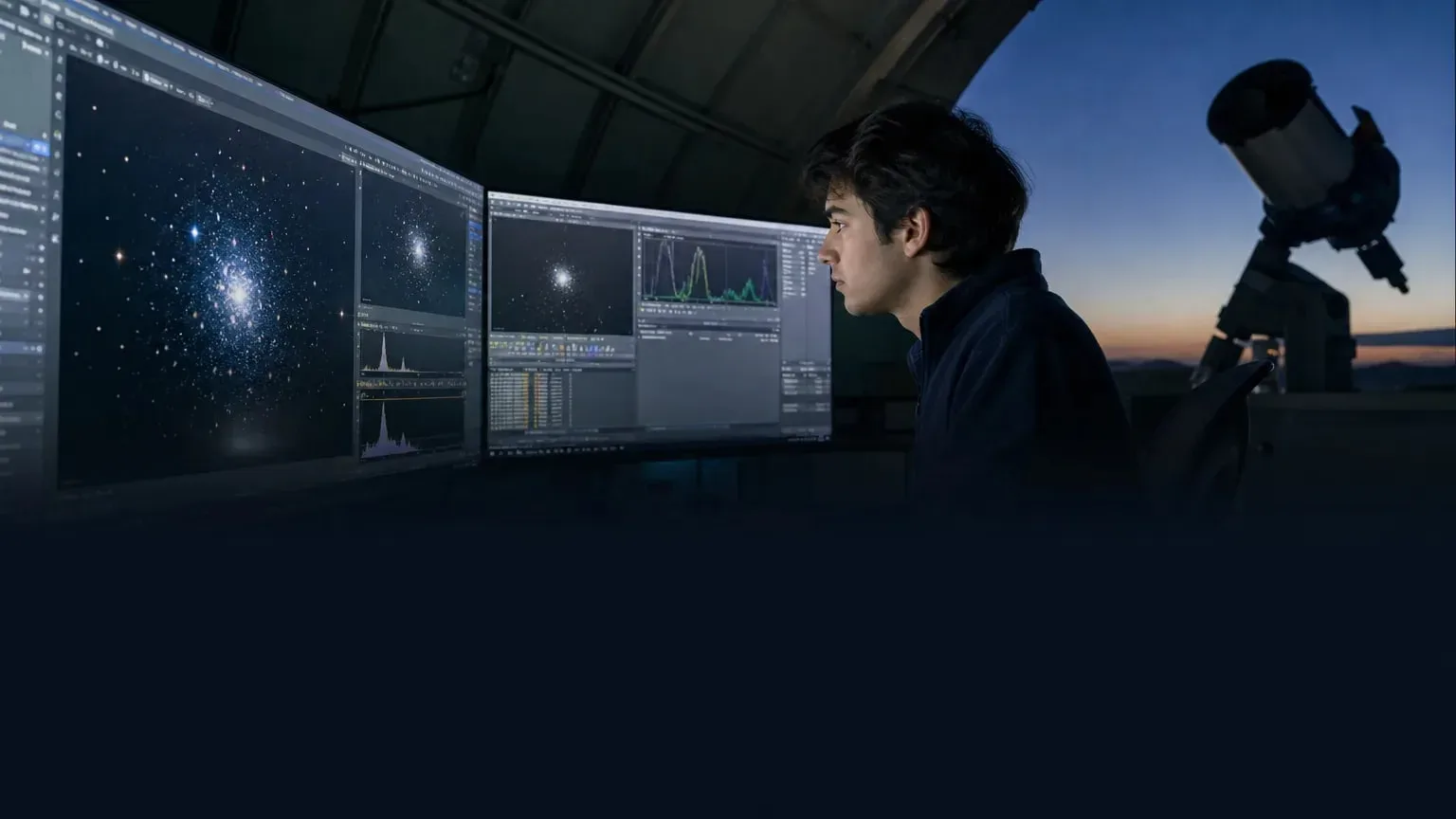
A first-year UC Berkeley astrophysics student has identified three unusual dwarf galaxies that are both isolated and quenched, a rare combination that could help explain how some galaxies stop forming stars. The study, published Oct. 6, 2026 in The Astrophysical Journal, presents the galaxies as possible backsplash candidates — systems that may once have passed close to a larger galaxy before being flung back into deeper space.
Key facts
- Julian Shapiro, an undergraduate astrophysics student at UC Berkeley, is the sole author of the paper.
- The study identifies three dwarf galaxies: Shapiro Dwarf Galaxies I, II and III.
- The galaxies are both isolated and quenched, which is unusual because isolated dwarf galaxies are typically expected to keep forming stars.
- The leading candidate large galaxy mentioned in the study is Messier 101, also known as the Pinwheel Galaxy.
- Shapiro is now in his first semester at Berkeley and plans to continue in astrophysics while working with Alex Filippenko’s research group.
What this means for students and early researchers
For undergraduates and aspiring astronomers, the main lesson is that archival telescope data can still lead to original discoveries. Shapiro said publicly accessible journals and archived observations helped him build the background, modeling code and analysis needed for the project while he was still in high school.
The practical takeaway for students is that research in astrophysics does not always begin with a telescope time allocation. In this case, the work relied on simulations and existing survey data, and Shapiro says follow-up observations from high-resolution space telescopes would help confirm whether the galaxies are truly isolated and whether they are backsplash systems.
- Field: astrophysics and cosmology.
- Research path: archival data, simulations, and distance estimates.
- Next step in the study: follow-up observations to refine the galaxies’ positions and test alternative explanations.
- Career context: Shapiro has already been named a 2026 Davidson Fellow and won the Astronomical League’s National Young Astronomer Award in 2025.
Why do these galaxies matter?
They matter because isolated dwarf galaxies are generally expected to keep forming stars, while quenched dwarf galaxies are usually found near large host galaxies where gas can be stripped away. Finding galaxies that are both isolated and quenched gives astronomers a concrete set of candidates to test whether backsplash processes can explain the mismatch.
Shapiro’s paper says the standard cosmological model, lambda-cold dark matter, predicts backsplash galaxies should be common, but they have been difficult to identify in the local universe. The new candidates may help close that gap by giving researchers objects to confirm with future observations.
How did Shapiro make the discovery?
Shapiro used simulations to estimate where backsplash dwarf galaxies would most likely appear near a Milky Way-like galaxy and where archive data could detect them. He then analyzed the observations to estimate distances and determine whether the galaxies were truly isolated.
The paper also proposes new methods for predicting how frequently these galaxies may occur. One of the galaxies, Shapiro Dwarf Galaxy II, may instead be a faint satellite of spiral galaxy NGC 5585, showing that more follow-up work is needed before the candidates are fully settled.
What comes next for the Berkeley student?
Shapiro is now taking astrophysics, math and physics courses at Berkeley as he works toward an eventual major. He will also join Alex Filippenko’s research group to study the Hubble tension, the disagreement over the universe’s expansion rate, and he hopes to do follow-up observations of the three galaxies.
His discovery has already been recognized by the Davidson Institute, and Berkeley’s astronomy faculty has highlighted the unusual combination of advanced research experience and undergraduate study.
FAQ
What are backsplash galaxies?
Backsplash galaxies are galaxies that may once have passed close to a much larger neighbor, lost their gas to environmental forces, and then been flung back outward into more isolated space. Shapiro’s paper says the three galaxies he identified are possible candidates for that category.
Why is isolation unusual for quenched dwarf galaxies?
Because dwarf galaxies in isolated regions are usually expected to retain cold gas and keep forming stars. When a dwarf galaxy is quenched, astronomers typically look for a nearby massive host galaxy that could have stripped that gas away.


