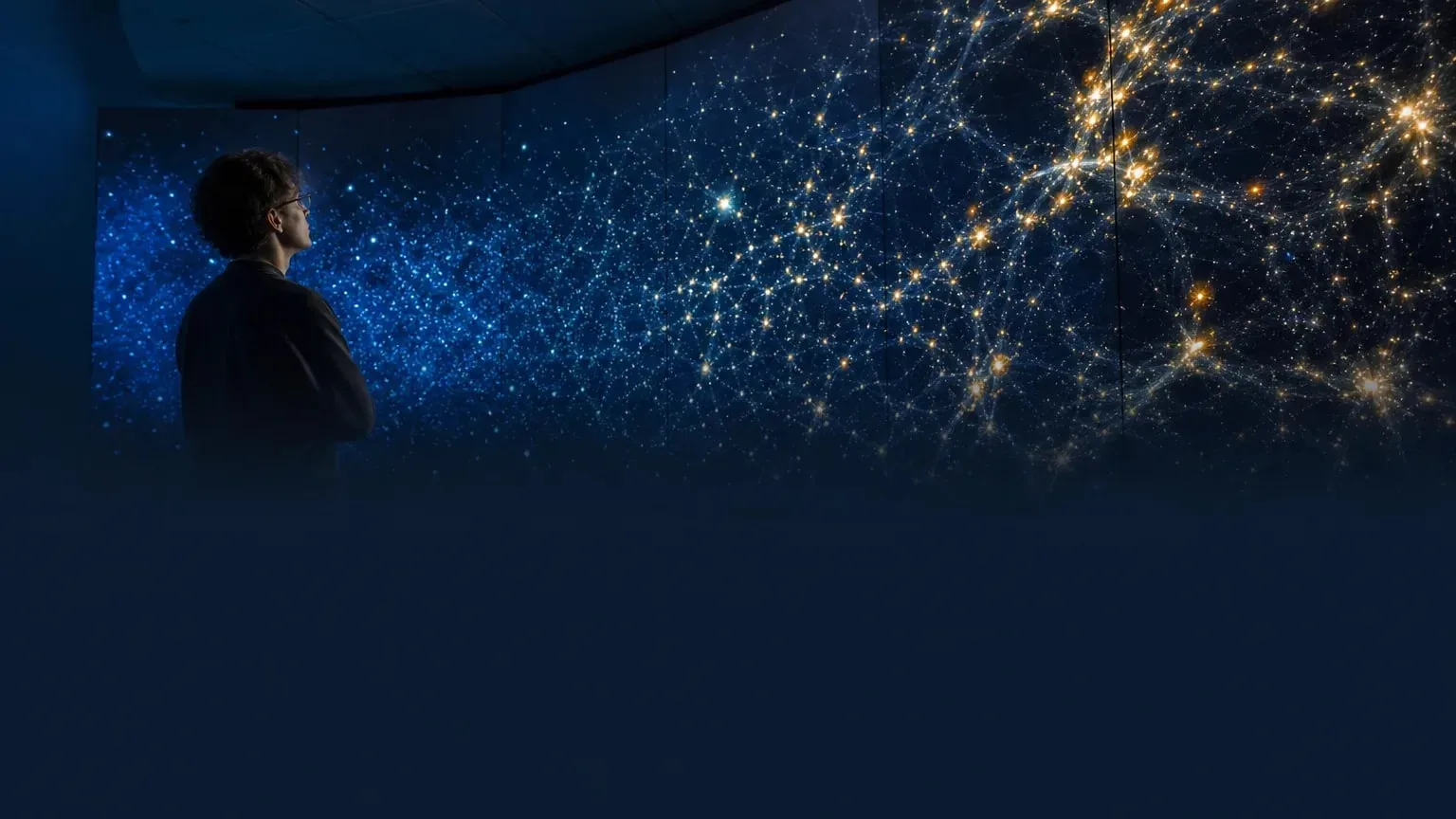
A new computer simulation called Lumina is giving scientists a detailed view of how the early universe may have evolved out of the cosmic “dark age” and into the first galaxies, stars and re-ionized gas. The work, published in Monthly Notices of the Royal Astronomical Society, combines galaxy formation and radiation transport in a single model that follows cosmic evolution for 2 billion years.
Key facts
- Lumina begins about 45 million years after the Big Bang, during the universe’s dark ages.
- The simulation spans 500 megaparsecs, or about 1.6 billion light-years.
- It tracks dark matter, gas, stars and radiation over 2 billion years of cosmic time.
- The project is based on the IllustrisTNG simulation and was run on the Frontier supercomputer at Oak Ridge National Laboratory.
- The team says Lumina captures both hydrogen re-ionization and helium re-ionization for the first time in one simulation.
What Lumina means for researchers studying the early universe
For astronomers and cosmologists, Lumina offers a new way to compare theory with observations from current and upcoming telescopes. The team says the simulation produces large populations of galaxies that can be matched against future survey data, which could help narrow down how the first galaxies and black holes formed.
The simulation also matters because it links small-scale processes, such as star formation inside galaxies, with large-scale cosmic re-ionization. That gives researchers a tool for studying how ultraviolet light from early galaxies and energetic light from supermassive black holes changed the state of hydrogen and helium across the universe.
- Who it affects: researchers studying early galaxies, cosmic re-ionization and large-scale structure.
- What it provides: high-resolution output across a much larger volume than previous best simulations, according to the team.
- What comes next: the researchers plan to use Lumina to map early large-scale structure and predict possible gravitational-wave patterns.
What does Lumina simulate?
Lumina tracks dark matter, gas, stars and radiation across a patch of the early universe that is 500 megaparsecs wide. The simulation starts in the dark ages, when neutral hydrogen dominated, and follows the universe through major changes in which hydrogen and helium became re-ionized.
According to the researchers, hydrogen re-ionization was driven by light from early galaxies and stars, while helium re-ionization was driven by much more energetic radiation from early supermassive black holes in active, accreting phases. The team says this is the first simulation to capture both processes.
Why does the simulation matter?
The researchers say Lumina bridges a major gap between very small and very large scales. It models half a trillion individual elements, including dark matter particles and gas cells, and does so at about 30 times the resolution of IllustrisTNG while covering about 100 times more volume than earlier simulations.
That combination makes it possible to follow the formation of dark matter haloes, the collapse of gas into galaxies and the spread of radiation outward from the first stars. The team says the simulation is intended to help interpret snapshots from new and future telescopes.
How was Lumina run?
The calculation required major supercomputing resources. The team ran Lumina on Frontier, the supercomputer at Oak Ridge National Laboratory in Tennessee, and says the calculation involved the equivalent of more than 100,000 CPU cores and around 15,000 GPUs at peak scale.
The project builds on IllustrisTNG, which was previously developed by scientists at MIT and elsewhere. For Lumina, the team refined that code so it could model galaxy formation in more detail over a much larger cosmic volume and combine it with radiation transport physics.
What happens next?
The team plans to use Lumina to map the large-scale structure of the early universe and to explore what gravitational-wave patterns early galaxies and black holes might produce. They also say the simulation can be compared with data from upcoming telescope surveys as those observations become available.
In that sense, Lumina is not just a visual reconstruction of the early universe. It is also a testbed for checking whether the physics built into today’s models can reproduce the structure astronomers expect to find in real data.