
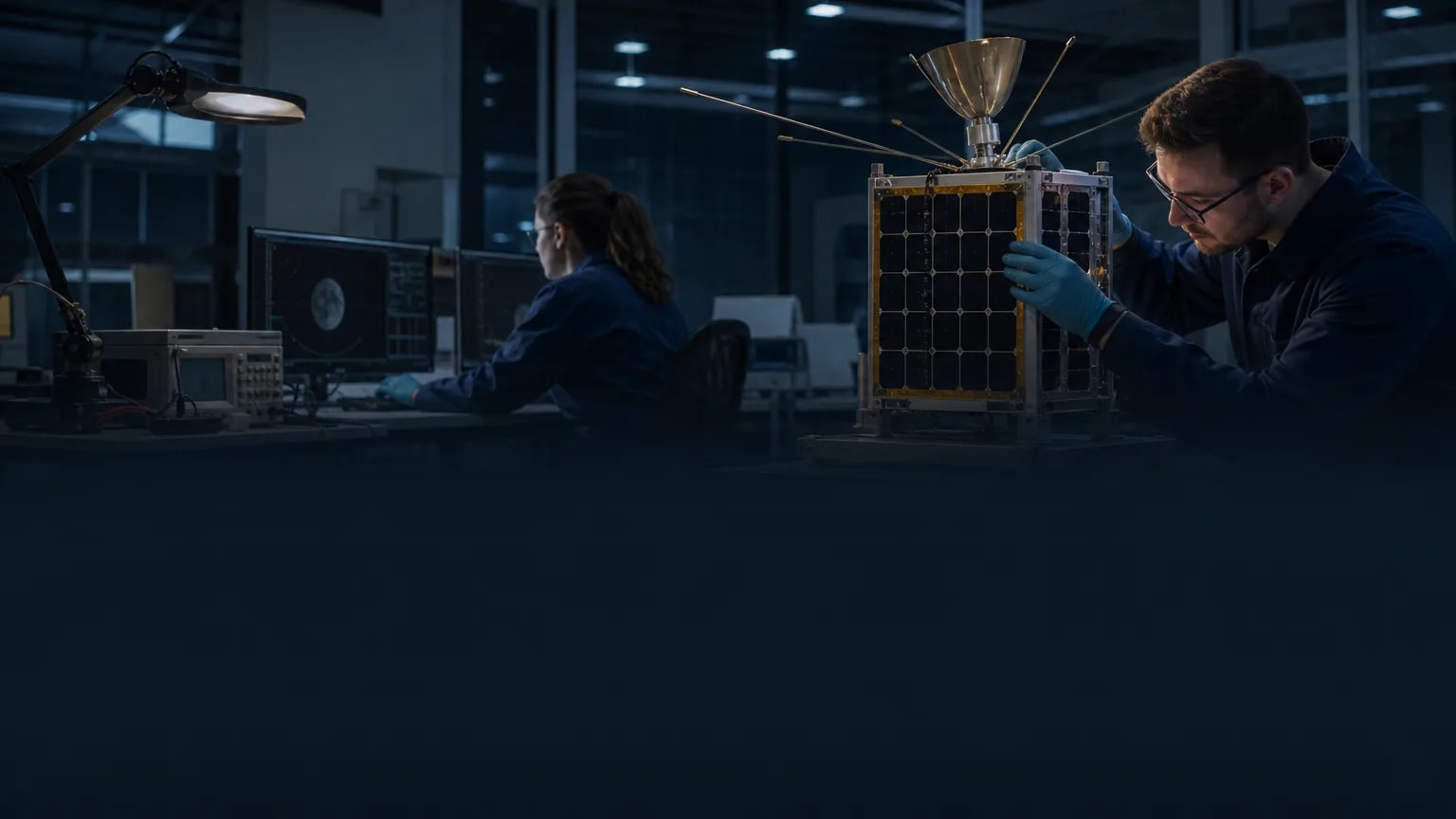
A University of Cambridge-led international team plans to send the compact CosmoCube satellite into lunar orbit to search for a hydrogen signal from the universe’s cosmic dark ages. On the far side of the Moon, the spacecraft would be shielded from terrestrial radio interference for about 40 minutes of each two-hour orbit, helping it make measurements that are not possible from Earth. The mission could probe an era before the first stars appeared and provide evidence about the early role of dark matter.
Key facts
- CosmoCube is a UK-developed small satellite, roughly the size of a small carry-on suitcase.
- It is designed to observe the 21-centimetre line emitted by hydrogen atoms during the cosmic dark ages and Cosmic Dawn.
- The satellite would observe at frequencies of 10 to 50 MHz while passing behind the Moon, away from Earth’s radio noise.
- Across an expected two-year mission, the team aims to collect 1,000 hours of data.
- The project has received UK Space Agency funding, and its researchers hope it can launch within five years.
Why use the dark side of the Moon?
The dark side of the Moon is central to CosmoCube’s observing strategy because the lunar body can block noise from Earth while the spacecraft is on the far side. Earth-based efforts face two major obstacles: the ionosphere blocks the relevant low frequencies, while FM radio, telecommunications and satellites add interference that can overwhelm the faint cosmic signal.
The target is the 21-centimetre line from hydrogen atoms in the interval between the Big Bang’s afterglow and Cosmic Dawn, when the first stars formed. The team describes this as a period roughly 150 million years long, and says it has not been directly observed. A detection would allow researchers to investigate how the universe changed from a dark, nearly empty state into the structures seen today.
What will CosmoCube measure, and why does it matter?
CosmoCube will attempt to measure extremely faint radio emission from early hydrogen at 10–50 MHz, using a long, lightweight antenna deployed in lunar orbit. The measurement could help researchers study the formation of the first stars and galaxies and examine how dark matter helped pull hydrogen together in the early universe.
During far-side passes, the satellite is expected to receive the shielding required to observe the signal while retaining a view of space. The project’s scientific plan also depends on separating the sought-after emission from much brighter radio foregrounds, especially emissions from the Milky Way.
How the small satellite is designed to handle a difficult measurement
The spacecraft will use a fully integrated miniature radiometer based on RF-Systems-on-Chip technology. It will repeatedly compare the sky signal with built-in reference sources through a Dicke-switched calibrator, a process intended to correct electronic drifts and internal noise that might otherwise resemble a cosmic signal.
After data return to Earth, researchers plan to use Bayesian statistical methods to remove foreground noise. They also plan to combine computer simulations with in-flight measurements to reconstruct the antenna’s response across the sky and subtract remaining distortions.
Surrey Space Technology Limited is developing the SSTL-21 platform in the UK. Instrument development includes functioning laboratory prototypes and environmental testing. Cambridge’s academic partners include the University of Portsmouth and STFC RAL Space, with participation from Malta; the team also took part in the European Space Agency’s mini-Fast missions Call for Ideas, which targeted mission costs below €50 million.
What this means for researchers and universities
For researchers, CosmoCube is a proposed route to observations that ground-based radio telescopes cannot make at the needed frequencies. For the participating universities and research organisations, the mission combines cosmology, radio-instrument design, spacecraft thermal testing, calibration and statistical data analysis. The work involves the University of Cambridge, the University of Portsmouth, STFC RAL Space, Surrey Space Technology Limited and international collaborators.
A race to preserve a quiet lunar radio environment
The project comes as the far side of the Moon is attracting wider interest for radio astronomy and other missions. The CosmoCube team notes that missions from the United States, India and other countries are being planned to make use of the Moon’s radio silence, meaning this unusually quiet observing environment may not remain unchanged indefinitely.
Details of the proposed mission were published in Nature Astronomy in 2026. The work was supported in part by the UK Space Agency, the Kavli Foundation and the Science and Technology Facilities Council, which is part of UK Research and Innovation.
Frequently asked questions
Why can’t CosmoCube make these observations from Earth?
Earth’s ionosphere blocks the 10–50 MHz frequencies CosmoCube is designed to use, and radio transmissions, telecommunications and satellites create interference. Lunar far-side passes would place the Moon between the spacecraft and Earth, reducing that terrestrial noise.
When could CosmoCube launch?
The researchers hope CosmoCube can launch within five years. The project has UK Space Agency funding, while its instrument work includes laboratory prototypes, environmental testing and development of the SSTL-21 spacecraft platform.


