
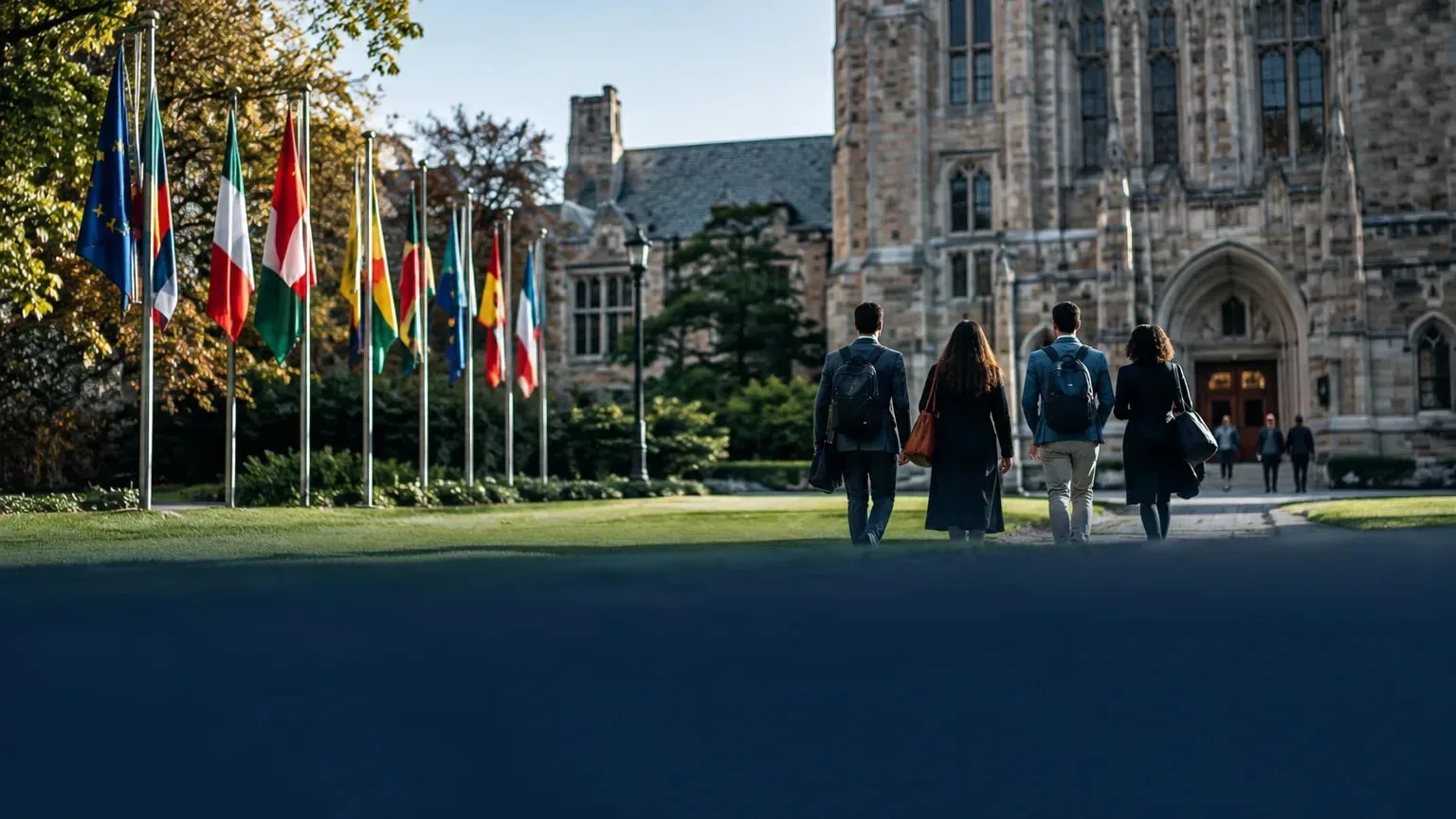
Yale Law School is marking the 150th anniversary of its graduate programs by spotlighting their international reach and their role in debates over the rule of law. At a two-day symposium in October, alumni and guests from countries including Brazil, Chile, France, Israel, Italy, South Africa, the United Kingdom, the United States, Canada, New Zealand, and Argentina discussed how legal education, scholarship, and public service travel across borders — and why that exchange matters as the United States faces new threats to the rule of law.
Key facts
- Yale Law School said its graduate programs date to 1876, when the School offered a Master of Laws degree.
- The anniversary symposium in October brought together alumni working as scholars, teachers, and practitioners across multiple countries.
- The program is intentionally small, with Yale saying it usually enrolls no more than 30 LL.M. students a year.
- Speakers said the symposium focused on what American scholars and policymakers can learn from other governments and societies that have faced rule-of-law challenges.
How the anniversary was framed
Dean Cristina M. Rodríguez said the School’s graduate students have not only carried Yale’s legal training into other countries but have also reshaped the School itself. She described a two-way exchange in which students arrive with questions formed by their own legal systems and public experiences, and those questions influence what Yale studies, teaches, and learns.
That idea fit the theme of the anniversary gathering. According to Yale Law School, the October symposium examined efforts to revise and restore the rule of law through an interdisciplinary and transnational approach. The discussion centered on lessons the United States might draw from other governments and societies that have struggled with similar pressures.
What makes Yale’s graduate program distinct?
One feature repeatedly emphasized by alumni and administrators was scale. Ayelet Shachar, now a professor at UC Berkeley School of Law, said some law schools enroll more than 200 LL.M. students, while Yale’s program is intentionally small and usually has no more than 30 students a year. Yale also says LL.M. students are not taught in separate courses or by separate faculty, but instead study as part of the wider institution.
That structure, according to program leaders and alumni, is meant to create close networks while avoiding a divide between graduate students and J.D. students. Shachar said the experience allowed students to become part of the School’s intellectual life inside and outside the classroom, while Director of Graduate Programs Carrie Field said graduate students are fully integrated into the institution.
Professor Harold Hongju Koh said international students add perspectives shaped by different legal systems and social conditions, including places without juries or places affected by war or religious conflict. He said those experiences can change how legal actors think about the role law can or should play.
What this means for students, applicants, and researchers
For prospective graduate students, Yale’s anniversary message is that the School sees its graduate programs as internationally oriented, research-focused, and deliberately small. The evidence supplied by Yale says the LL.M. cohort is usually capped at no more than 30 students a year, and that graduate students study alongside J.D. students rather than in a separate track. That suggests applicants should expect a highly integrated academic setting built around scholarship and cross-border exchange.
For current students and alumni, the symposium also signals the kinds of conversations Yale is elevating now. The October event focused on rule-of-law pressure in the United States and abroad, and on what American scholars and policymakers can learn from countries that have already faced comparable challenges. For researchers working on public law, international law, comparative law, or interdisciplinary legal studies, that emphasis points to a practical next step: engage with transnational examples rather than treating U.S. experience as self-contained.
- Who is affected: Current and prospective LL.M., J.S.D., M.S.L., and Ph.D. students, along with alumni and scholars in related fields.
- What stands out: Yale describes the graduate programs as small, flexible, interdisciplinary, and closely connected to the rest of the Law School.
- Why it matters: The symposium framed international experience not as an add-on, but as central to how Yale understands legal scholarship and the rule of law.
How the programs grew over time
Yale Law School traces its graduate offerings to 1876. Dean Rodríguez said one member of the inaugural graduate class later became the School’s first professor of international law, which she cited as evidence that the programs had global ambitions from the beginning. Yale also noted that John Howard Whiting became the first student to receive the Doctor of Civil Law degree from the graduate programs in 1878.
The School’s account says outside funding helped shape later expansion. A substantial 1955 Ford Foundation grant, it said, supported growth in the 1960s and had strengthening international legal studies among its goals. Yale’s historical materials describe that period as part of a broader effort to train lawyers and law teachers who would contribute to justice and social order.
Another expansion came in the 1970s with the Master of Studies in Law, or M.S.L., a one-year degree intended for nonlawyers seeking a grounding in legal thought and its relation to other disciplines. Yale said the program was aimed in part at researchers and teachers whose primary expertise lay outside law but intersected with legal questions.
Why did the symposium focus on learning from other countries?
Because participants said the older idea of exporting legal wisdom outward is no longer enough. The symposium’s premise, as described by alumni speaker Ayelet Shachar, was that the United States can also learn from countries that have already confronted strain on the rule of law. That marked a shift from a one-directional model toward a more reciprocal one.
Shachar said the reversal matters because it challenges the assumption that all the relevant expertise sits in the United States. She pointed to examples discussed at the symposium from China, Poland, Canada, and elsewhere, and said the conversation showed both the pressure facing domestic and international legal systems and the value of comparative, cross-border scholarship in responding to it.
Monika Ehrman of SMU Dedman School of Law said the symposium acted as a catalyst for people concerned about the rule of law and encouraged current students to see the School’s past and present networks as part of shaping the future.
FAQ
What anniversary was Yale Law School celebrating?
Yale Law School was marking 150 years of its graduate programs. The School traces those programs to 1876, when it offered a Master of Laws degree.
What was the main focus of the October symposium?
The symposium focused on what American scholars and policymakers can learn from other governments and societies that have struggled with challenges to the rule of law, and on efforts to revise and restore the rule of law through an interdisciplinary and transnational approach.


