
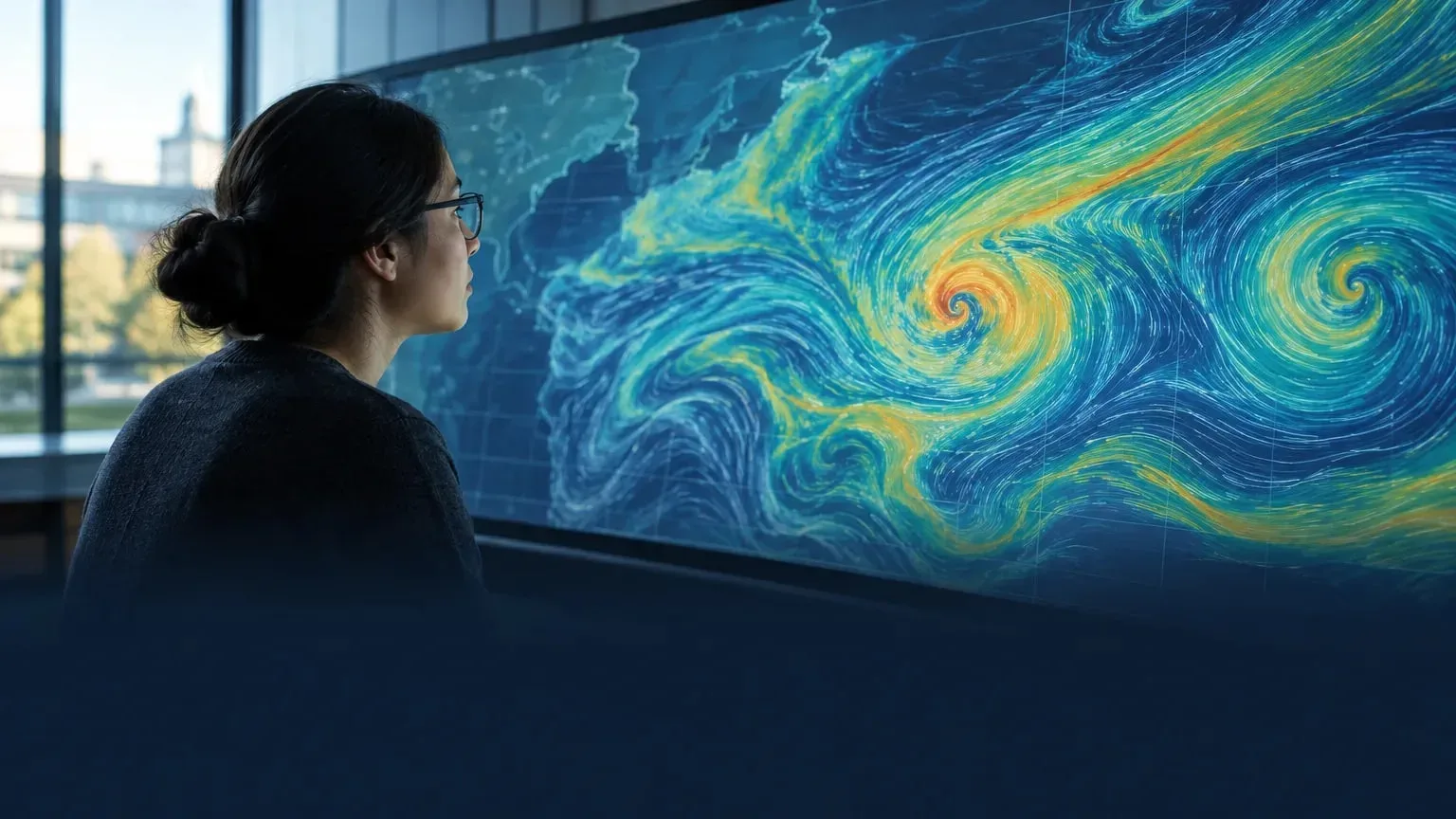
Researchers at MIT have reported a new way to keep AI models of chaotic physical systems from drifting into impossible predictions over time. The method adds physics-based hard constraints to machine-learning models so their long-run forecasts remain bounded, a result the team says matters for areas including weather, climate, turbulence, hydrology, and industrial processes.
Key facts
- The work was published in the Proceedings of the National Academy of Sciences by Sunbochen Tang, Navid Azizan, and Themistoklis Sapsis.
- The approach uses energy-based constraints and a projection layer to enforce bounded behavior in model predictions.
- The researchers say this is the first work to establish formal guarantees of boundedness for machine-learning models of chaos.
- The team tested the method on systems ranging from simple textbook examples to complex multidimensional cases.
- The paper and open-source code are accessible online through PNAS.
Why does boundedness matter in chaotic AI models?
It matters because a model can fit short-term data and still become unusable when run longer, with small errors building into values that would not occur in the real system. MIT’s team argues that chaotic behavior does not remove physical limits, so prediction systems should preserve complexity without allowing artificial runaway behavior.
The problem appears in a wide set of dynamical systems. The researchers point to weather and climate patterns, turbulent flows in aviation, ocean currents, hydrology, and industrial processes as examples where accurate modeling is difficult but practically important. In those settings, tiny differences in starting conditions can lead to very different outcomes, which makes long-term prediction especially hard.
According to the researchers, existing machine-learning approaches often struggle here because they can match observed data over a short interval yet still fail once simulations continue over longer periods. That can produce unbounded outputs that are physically impossible.
How the MIT method works
The new method is built around what the team describes as energy-based constraints. Instead of simply penalizing bad behavior during training, the model learns an energy-like function and a boundary that should contain the chaotic dynamics. A projection layer then adjusts predicted evolution so that energy dissipation is enforced as a hard constraint outside that boundary.
In practice, the researchers say this means the simulated system is pulled back toward a bounded region rather than being allowed to diverge without limit. The result, they report, is a theoretical guarantee that model predictions remain bounded even over arbitrarily long forecast windows.
That is a different strategy from what the authors describe as soft-constrained methods, which try to encourage desirable behavior during training but do not guarantee it once the model is deployed on new inputs. The MIT team frames its contribution as a hard-constrained neural-network approach aimed at making outputs physically consistent even in previously unseen cases.
What this means for researchers and practitioners
For researchers who build data-driven models of physical systems, the main practical implication is that boundedness is being treated as a guaranteed property rather than a hoped-for outcome. The method is described as broadly applicable to chaotic systems and modular enough to work with different neural-network architectures, which could make it relevant across multiple research areas rather than only one specific benchmark.
The team says the approach may be especially useful where data is limited. In those settings, physics can serve as an additional source of information alongside observations, which may help when the large datasets that often benefit AI systems are not available. That makes the work potentially relevant to scientists and engineers working in weather, fluid dynamics, aeronautics, hydrology, and other domains where collecting data can be difficult or expensive.
- The paper is published in PNAS.
- The authors say open-source code is available online with the paper.
- The team plans to continue testing the method on larger systems, including data-driven models of realistic weather systems.
What did the researchers test?
The team says it evaluated the method on a range of physical systems, from simple textbook cases to highly complex multidimensional systems. In those tests, the researchers report that their approach tracked true outcomes closely, while conventional approaches soon departed into impossible predictions.
The evidence provided does not list individual benchmark systems or performance figures, but it does establish the scope of the testing and the central comparison the authors draw with existing methods.
Why this could matter beyond one paper
The researchers present the work as part of a broader push toward trustworthy AI for physical modeling. Rather than relying only on evidence that a model usually works, they argue that high-stakes applications need guarantees about properties that must always hold. In this study, that guaranteed property is boundedness.
The team also says the projection layer is model-agnostic, which could make the approach easier for other researchers to adapt. A follow-up paper by members of the team was presented this year at the Learning for Dynamics and Control conference, where it won the Best Paper Award.
FAQ
What problem does this research try to solve?
It addresses a common failure mode in machine-learning models of chaotic systems: predictions that drift into physically impossible values over time. The MIT team says its method keeps model trajectories bounded while still allowing complex chaotic behavior.
Where could this approach be used?
The researchers say it is broadly useful for chaotic systems, including weather and climate modeling, turbulent flow problems in aviation, ocean currents, hydrology, and industrial processes.
Who published the work?
The paper was published in the Proceedings of the National Academy of Sciences by MIT researchers Sunbochen Tang, Navid Azizan, and Themistoklis Sapsis.


