
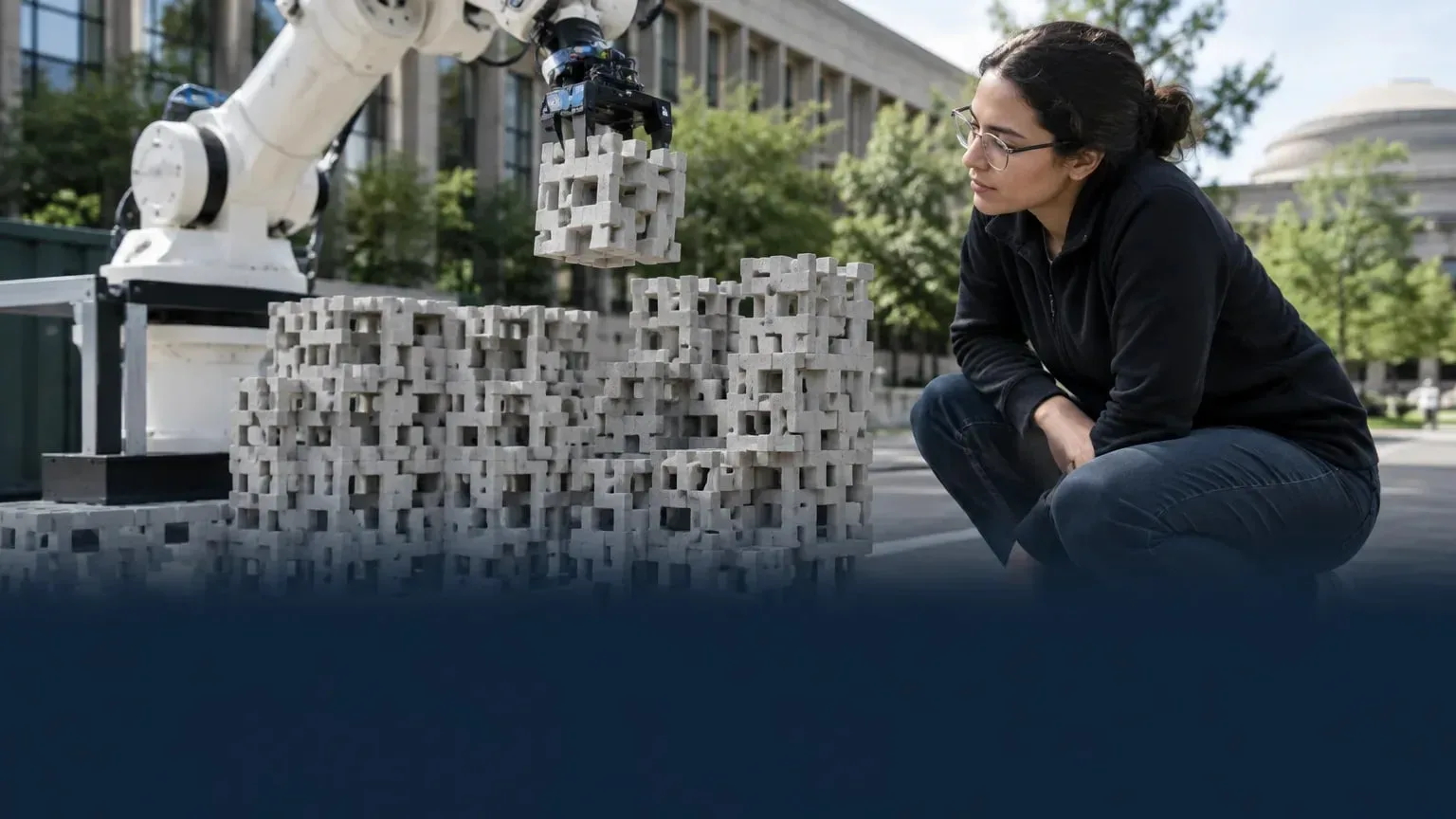
An MIT researcher is developing a modular building system that uses load-bearing lattice blocks, or “voxels,” to let comparatively inexpensive, lower-precision robots assemble structures with less material. The work matters because construction is often cited as contributing more than one-third of global greenhouse gas emissions, and Smith estimates buildings made with this approach could cut embodied carbon emissions by roughly 80 percent compared with standard concrete construction.
Key facts
- Miana Smith’s MIT research centers on voxel blocks that snap into place and can be assembled by robots with about 10 millimeters of error tolerance.
- Smith says structural steel buildings can often remove an estimated 30 to 40 percent of steel through customized beam cross sections without weakening them.
- Smith estimates the voxel-based approach could cut embodied carbon emissions by roughly 80 percent compared with standard concrete construction.
- The system has been demonstrated at room scale, including a small load-bearing house built from plywood blocks.
- The research is being tested with Druk Holding and Investments for the Gelephu Mindfulness City housing development project in Bhutan.
How does the voxel system change building construction?
It shifts the challenge from making extremely precise robots to designing building components that can absorb assembly error. Smith’s blocks are mechanically designed to snap into place in a way she compares to Lego bricks, allowing a relatively imprecise assembler to produce a precise result. In her account, that means lower-cost robots can work in parallel instead of relying on a single expensive industrial machine.
The idea responds to a long-standing problem in construction: engineers may know how to use less material, but custom parts can be expensive to manufacture and require skilled labor to install. Builders therefore often rely on oversized, uniform parts because they are cheaper to produce and assemble at scale.
Digital fabrication methods such as 3D printing and robotic assembly can offer more design flexibility, but Smith argues that building-scale work usually demands machines accurate to a few millimeters across large spans. Those machines are difficult to manufacture and expensive. Her approach reverses that logic by using a more complex building unit so the robot itself does not need industrial-grade precision.
What practical impact could this research have?
The immediate impact is for researchers, builders, and developers looking for lower-carbon construction methods that do not depend on highly precise and costly industrial robots. Smith’s system is designed to work with multiple materials, including plywood, bio-based plastics, aluminum, and steel, using the same underlying joint design. That gives the research potential relevance across different building methods rather than tying it to a single material.
For people working in architecture, engineering, and construction, the project points to a practical tradeoff: instead of paying for extreme robotic precision, teams may be able to redesign the building unit itself to make assembly more tolerant of error. Smith says her robots have an error margin of about 10 millimeters, and because they do not need industrial-grade precision, they can cost a few hundred dollars apiece instead of tens of thousands.
- Who is affected: Researchers in digital fabrication, construction firms, and housing developers testing lower-carbon building systems.
- Where it is being tested: MIT demonstrations and a collaboration tied to the Gelephu Mindfulness City housing project in Bhutan.
- What has been built so far: Room-scale, load-bearing demonstrations, including a small house made with plywood blocks.
- What comes next: Outdoor tests at a similar scale and further work using reconfigurable block logic as formwork for concrete.
Why does the design focus on bigger, pre-connected blocks?
Because reducing the number of vulnerable connections made robotic construction more viable at larger scale. Smith said her team had spent a long period building with small individual units that each needed as many as 24 connectors, creating repeated opportunities for structural weakness and assembly failure.
Her solution was to make the blocks larger and attach as many internal joints as possible before a robot handled them. She described that as introducing an error-correction feature that is structurally active. The team also changed the lattice itself, moving to a more heavily internally connected, stretch-dominated structure because Smith said it performs better on weight-to-stiffness and weight-to-strength measures than a bending-dominated lattice.
Where is the work being tested now?
The research is moving from lab development to field testing through a collaboration with Druk Holding and Investments in Bhutan. The project is tied to the next housing development phase of Gelephu Mindfulness City, where officials wanted construction methods based on local materials and capable of being reconfigured over time.
Using plywood blocks, Smith’s team has already built room-scale, load-bearing demonstrations, including a small house. The next planned step is outdoor testing at a similar scale. Smith is also pursuing a startup through an Activate Fellowship focused on more sustainable concrete construction, extending the same reconfigurable logic into concrete formwork.
FAQ
What are voxels in this construction research?
They are small lattice building blocks designed to snap into place so robots can assemble load-bearing structures even without industrial-grade precision. Smith’s team has made them from materials including plywood, bio-based plastics, aluminum, and steel.
How much could the system reduce emissions?
By Smith’s estimate, buildings made with this approach could cut embodied carbon emissions by roughly 80 percent compared with standard concrete construction.
Where is the system being tested outside the lab?
Smith’s team is collaborating with Druk Holding and Investments in Bhutan on the Gelephu Mindfulness City housing development project, where the approach is being explored for sustainable, reconfigurable construction.


