
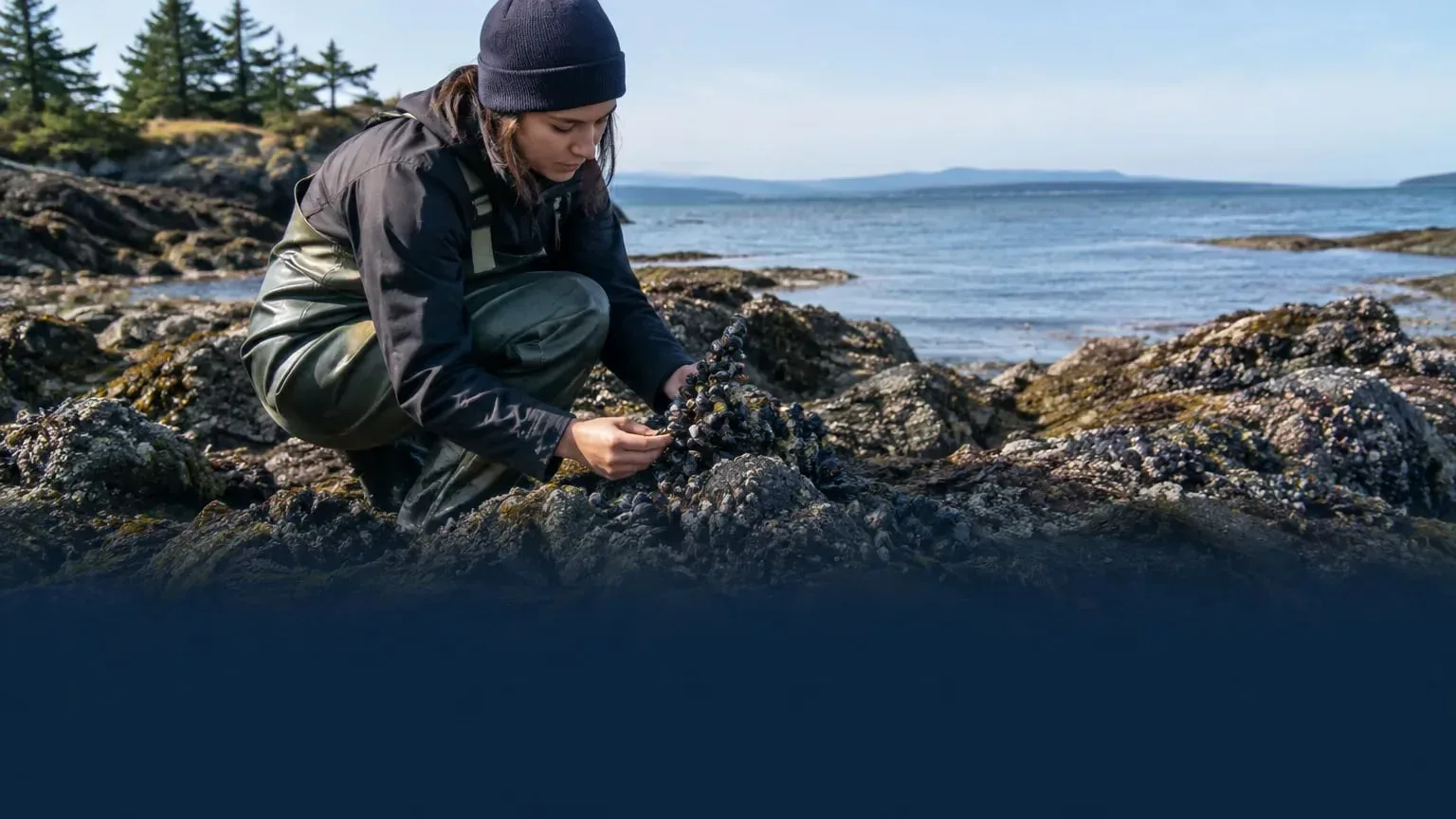
A University of Washington study found that mussel survival during the 2021 Pacific Northwest heat dome depended on both size and position on the shore at Cattle Point on San Juan Island. Small mussels higher on the shore and larger mussels lower down survived better, while mid-size mussels were most vulnerable during the extreme heat event.
Key facts
- The study examined mussel mortality after the 2021 Pacific Northwest heat dome at Cattle Point on San Juan Island.
- Researchers found a survival pattern that favored small mussels high on the shore and large mussels lower on the shore.
- Mussels higher on the shore are exposed to sunlight for nearly twice as long as mussels lower down because of the tides.
- The team used long-running temperature records from biomimetic “robomussels” and built a physics-based heat budget model.
- The paper was published Nov. 18 in Proceedings of the Royal Society B.
The work, conducted at the University of Washington’s Friday Harbor Laboratories, focused on mussels covering the rocky shoreline at Cattle Point. Before the heat wave, researchers had already been collecting temperature data there for decades using biomimetic “robomussels,” devices designed to mimic the size, shape, color and thermal properties of real mussels.
That long record helped researchers examine what happened after the heat wave brought 100-degree weather to a region more accustomed to highs in the mid-70s. Many marine organisms died in the midday sun, but the Cattle Point mussels as a whole fared relatively well. When the team returned one, two and three weeks after the onset of the heat wave to count freshly dead mussels, the overall mortality was low, yet the size pattern stood out.
What did the study find about heat dome survival?
The main result was that being average was a disadvantage. Researchers had expected that the upper shore, where small mussels are more common, would show more deaths among small animals, and that the lower shore, where larger mussels dominate, would show more deaths among large ones. Instead, they found the opposite pattern: mussels that died high on the shore were bigger than average, while those that died lower down were smaller.
Lead author Jack Litle, who recently completed his doctoral studies in biology, and senior author Emily Carrington used those observations to develop a heat budget model based on mass and heat transfer. According to the study, the pattern can be explained by how body size changes the balance between heat gain and cooling in different parts of the shore.
Why did mid-size mussels fare worst?
At Cattle Point, shore height changes how long mussels remain exposed to the sun. Mussels higher on the shore are left in sunlight for nearly twice as long as those lower down. That means the same body size can face different risks depending on where it is attached.
Mussels cool themselves in two ways: by releasing seawater for evaporative cooling and through wind. Larger mussels retain more seawater than smaller mussels, which extends the period when evaporative cooling can work. Smaller mussels, however, have a greater surface-area-to-volume ratio, making them better at cooling in the wind.
That tradeoff helps explain the mortality pattern. High on the shore, mussels that died were likely large enough to lose the advantage of efficient wind cooling after running out of water for evaporation. Lower on the shore, the mussels that died were likely too small to hold enough water for prolonged evaporative cooling. In other words, size was not simply good or bad on its own; it interacted with habitat.
What this means for shellfish growers and coastal research
The findings matter beyond one rocky shoreline because the model is physics-based and the study says it can be applied to other shellfish and to other coastal areas that experience tides. For researchers, that means existing temperature records and shore-position data may help predict which animals are most vulnerable during future extreme heat events.
For the shellfish industry, the study points to a practical size-related constraint during hot weather. Oyster growers, the study notes, keep oysters low on the shore to fatten them up before moving them higher to strengthen their shells. This research suggests there may be a point at which larger shell size raises heat-mortality risk after that move, making size and shore placement part of the same management decision.
- Who is affected: shellfish growers, coastal ecologists and others studying intertidal species.
- Where: the study was conducted at Cattle Point on San Juan Island at Friday Harbor Laboratories.
- Why it matters: heat risk during extreme weather may depend on both body size and exact location on the shore.
- Next step suggested by the research: apply similar physics-based modeling to other shellfish and other tidal coastlines.
How was the study carried out?
The team relied on decades of temperature monitoring from robomussels placed at Cattle Point. These devices contain small thermometers inside black epoxy and are designed to experience temperatures similar to nearby live mussels. That gave the researchers continuous temperature records from the habitat before and during the heat event.
After the heat dome began, the researchers returned to the site over three weeks to count freshly dead mussels, identified by shells that had popped open. They then paired those observations with a physics-based model to test how body size, evaporation, wind cooling and shore height combined to shape survival.
The study was published Nov. 18 in Proceedings of the Royal Society B. Co-authors include Robin Fales of Soka University of America and Kindall Murie of Stanford University, both former doctoral students in the Carrington lab.
Could the model be used beyond mussels?
Yes. The study says the model can be applied to other shellfish in tidal coastal areas, and the authors also point to wider biological relevance. While the species differ, the same physical principles behind evaporative cooling can apply more broadly.
The researchers say a similar approach could eventually help explain heat responses in other evaporative coolers, including amphibians, birds and mammals. The biology would differ across those groups, but the study argues that the underlying heat-transfer framework can still be useful.
FAQ
Where was the mussel study conducted?
The research focused on Cattle Point, the southern tip of San Juan Island, using mussels living on the rocky shoreline there and temperature data collected through the University of Washington’s Friday Harbor Laboratories.
Why were mid-size mussels at greater risk during the heat dome?
The study found that cooling depends on a tradeoff between evaporative cooling and wind cooling. Larger mussels hold more seawater for evaporation, while smaller mussels cool better in the wind, leaving average-sized mussels at a disadvantage in some shore positions during extreme heat.
Can the findings help the shellfish industry?
Potentially yes. The study says its physics-based model could help shellfish growers judge how body size and shore placement affect heat-mortality risk, including for oysters moved to different parts of the shore during cultivation.


