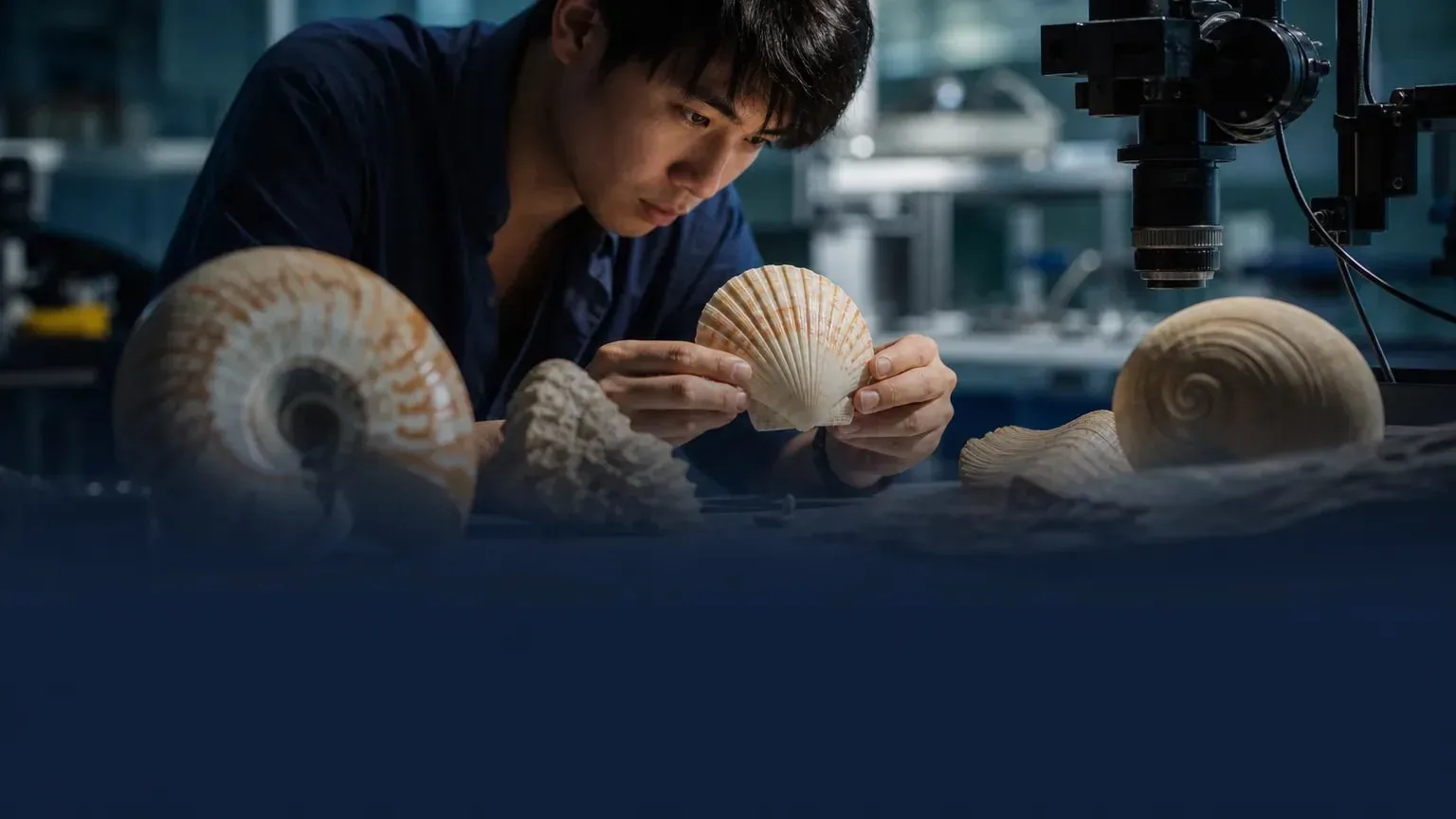
Caltech researchers say they have identified a mathematical way to explain why mollusks can build strikingly consistent shells across different environments. The work, led by engineer and materials scientist Kaushik Bhattacharya and postdoctoral scholar Huan Liu, describes shell growth with a small set of variables that can reproduce forms ranging from nautilus spirals to scallop fans.
Key facts
- The study was published in Proceedings of the National Academy of Sciences on October 23.
- The researchers say their model uses three elements: the shell’s growing-edge curve, a scaling factor, and a rotation angle.
- The approach can reproduce the characteristic shells of almost any class of mollusk.
- The team says the process is passive and energy efficient, and could inspire manufacturing of complex parts.
- The paper is titled “Local growth laws determine global shape of molluscan shells.”
Why this shell-growth model matters for engineering
For engineers and materials scientists, the practical significance is in the model’s simplicity: the researchers say many shell shapes can emerge from repeated local growth at the edge of the shell, rather than from a system that tracks the whole structure. That makes the result relevant to efforts to design gentler, less energy-hungry ways to make complex parts.
The researchers specifically point to possible uses in manufacturing specialized manifolds for jet engines. Their framework suggests that changing just two values in the growth law can produce markedly different shells while preserving the overall repeatable form.
- What drives the shape: the initial curve, the growth rate, and the angle of rotation.
- What stays stable: the overall shell form remains repeatable even when growth rate changes or a small defect is introduced.
- What may follow: new manufacturing methods that mimic passive biological growth.
How do mollusks keep making the same shell?
The researchers say the answer is a repeating growth rule at the shell’s leading edge. Once the protoconch is established, each step of growth determines the next, and new material is added only along that curve. In the model, the whole shell can be rebuilt by repeating those local actions over time.
Bhattacharya and Liu say the shell’s growth lines preserve the same shape from one stage to the next, with differences captured by scaling and rotation. That led them to describe the process with a Lie group, a mathematical framework for repeated smooth actions.
What did the model show across mollusk classes?
The model was able to generate the shapes of nearly all known molluscan shells by changing the starting curve and the scaling factor. The researchers say the scaling value, lambda, is biologically meaningful: shells within the same mollusk class have nearly the same lambda, and the five shell-bearing classes each occupy its own narrow range of values.
Those classes are Gastropoda, Bivalvia, Cephalopoda, Monoplacophora and Scaphopoda. The finding suggests that shell shape is not just visually diverse but also organized by a small set of underlying growth parameters.
What does this mean for materials design?
The team says mollusk shells are both passive and energy efficient, because the animal does not need extra control to direct each later stage of construction. That is what makes the biology attractive as a design principle for manufacturing.
Bhattacharya said the results suggest gentler and less energy-hungry methods of manufacturing complex parts. The paper was supported by the Drinkward Postdoctoral Fellowship and the Howell N. Tyson, Sr., Professorship at Caltech.