
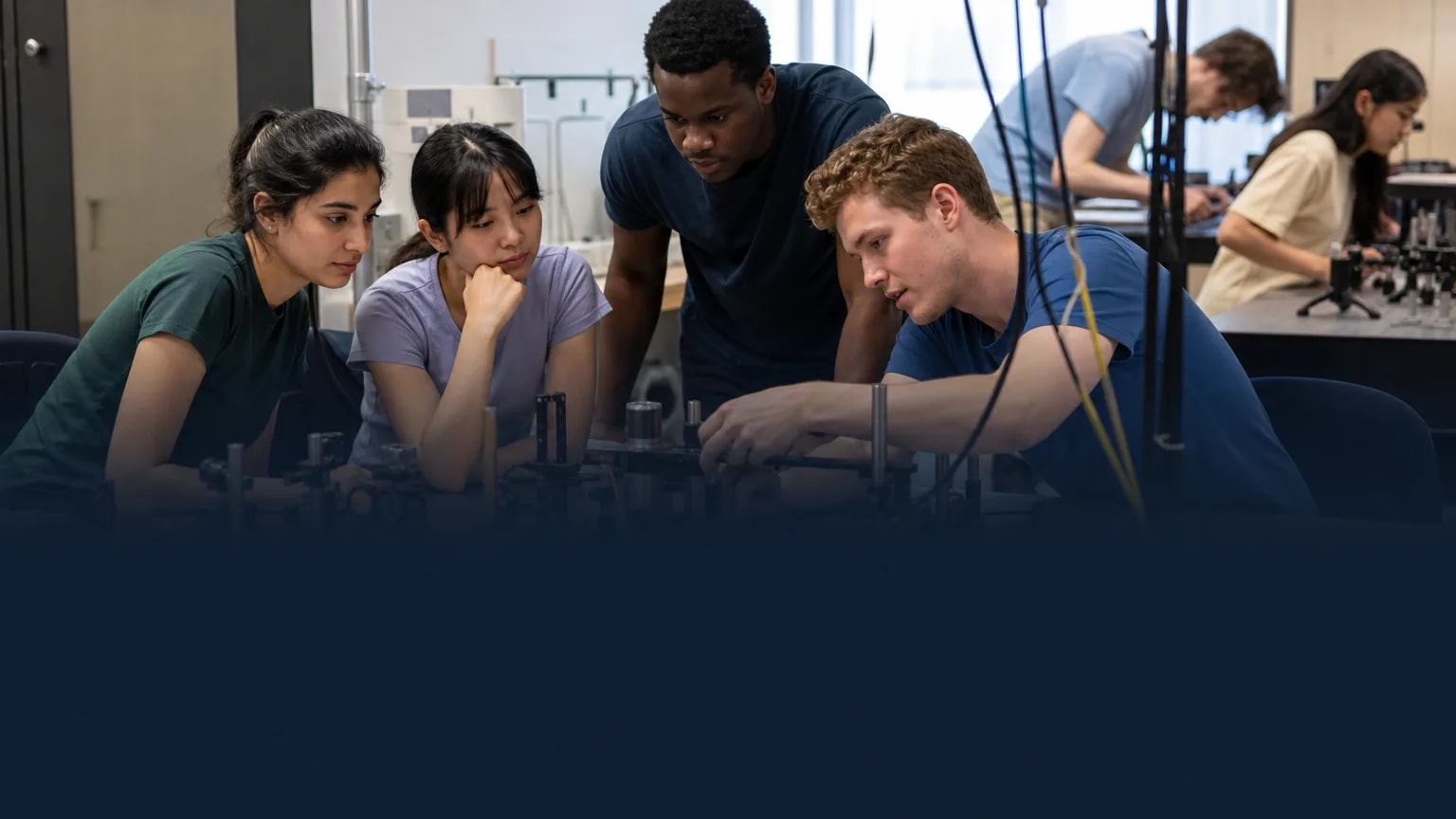
Yale Physics community members, including many from Wright Lab, taught three week-long workshops and two enrichment sessions in July for the 2026 Pathways to Science Summer Scholars Program. The free, two-week science program served more than 100 high school students from the Yale Pathways to Science program, combining hands-on physics, science communication and encounters with research topics.
Key facts
- The 2026 program was a free, two-week summer science program for more than 100 high school students in Yale Pathways to Science.
- Yale Physics community members taught three five-day workshops in July.
- Two 1.5-hour enrichment sessions introduced students to Wright Lab research and a particle-collider control-room scenario.
- Workshop topics included particle physics, the physics of light, and science communication through demonstrations.
What this means for students
For participating high school students, the program offered opportunities to work with physicists and explore how scientific questions are investigated. Activities ranged from computer simulations of proton-electron collisions to building tabletop demonstrations, examining light and color, and solving physics-themed puzzles with classmates.
The science communication workshop also asked students to create skits around large-scale physics demonstrations for the program’s closing ceremony. Students could contribute outreach materials to the Yale Physics Lecture Demonstrations repository while developing demonstrations such as a color mixer, a light-up weevil and an LED rainbow.
What did Pathways to Science Summer Scholars include?
The July program included three five-day Yale Physics workshops and two 1.5-hour enrichment sessions. Together, they covered particle physics, light, hands-on demonstrations, science communication, Wright Lab research and the operation of collider experiments through an escape-room activity.
In Let’s Smash Some Protons, Laura Havener and Isaac Mooney introduced questions about the composition of matter and its smallest particles. Students used computer simulations to smash protons with electrons and study the resulting debris, an activity modeled on the work of physicists at particle colliders.
The Physics of Light, taught by David Moore, Aaron Markowitz, Clarke Hardy, Joaquin Fernandez Odell, Katie Ream and Molly Watts, examined the visible and invisible properties of light and color. The workshop connected those properties with technologies including lasers and smartphones.
A third workshop, Physics Demonstrations: Make Words about Science Go Better, was taught by Caitlin Hansen, Matthew Ennis, Paul Noel and Emily Pottebaum. Its activities paired hands-on demonstrations with creative presentations, including soldering and the construction of tabletop physics demonstrations.
How did Wright Lab introduce research topics?
The Discover the Invisible Universe at Wright Lab session gave students a chance to interact with scientists while learning about experiment, observation and analysis. Wright Lab researchers investigate subjects including dark matter, neutrinos, matter and its interactions, quantum phenomena and the beginnings of the universe.
This year’s activities addressed wavelengths and ways to make sound and heat visible, as well as changing resonances and energy transfer. Students also encountered particle physics through accelerators constructed with a rod, electromagnetic coils and balls.
Nathan Burns, Natalie Chinganga, Emery Cunningham, Elise Le Boulicaut Ennis, Rachel Levine and Zach Muraskin served as instructors for the session. Victoria Misenti coordinated it, with support from Caitlin Hansen and Paul Noel.
A particle collider challenge in an escape room
The second enrichment session, RHIGscape Escape Room: Particle Collider Control Room, placed students in the role of experimental physicists working a shift at the Large Hadron Collider when something goes wrong. Participants worked with classmates to solve puzzles while learning about the experience of running large collider experiments.
Laura Havener, Isaac Mooney, Morgan Knuesel, Josie Rose, Bradyn Quintard, Emily Pottebaum and Ryan Hamilton were listed as instructors for the escape-room session.
Frequently asked questions
Who participated in the 2026 Pathways to Science Summer Scholars Program?
The free two-week program was exclusively for more than 100 high school students from the Yale Pathways to Science program. Yale Physics community members, including many Wright Lab community members, taught its physics workshops and enrichment sessions.
What were the enrichment sessions?
The two 1.5-hour sessions were Discover the Invisible Universe at Wright Lab and RHIGscape Escape Room: Particle Collider Control Room. They covered Wright Lab research processes and topics, plus a puzzle-based introduction to operating large collider experiments.


