
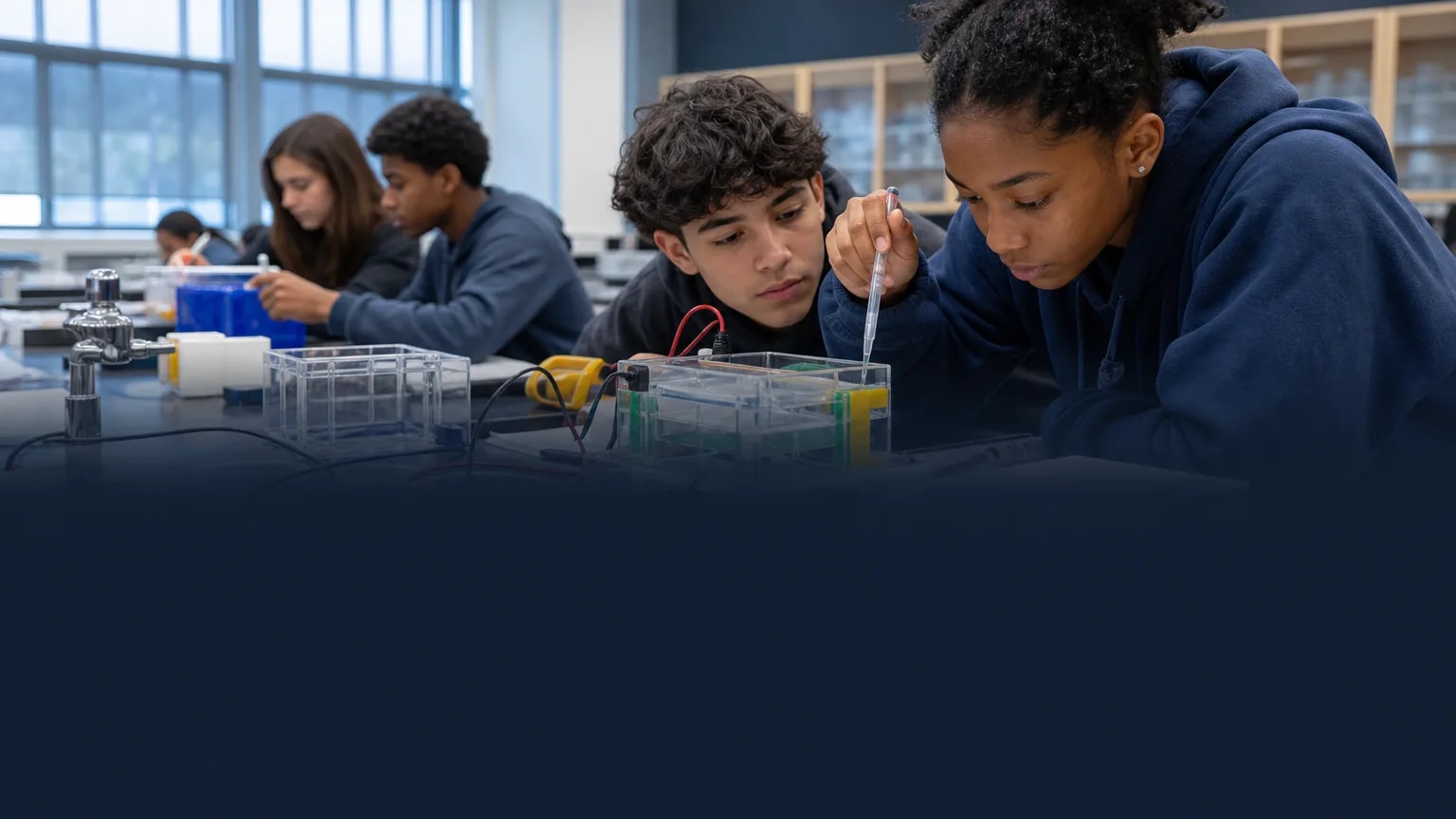
MIT’s Edgerton Center is bringing a hands-on, proteins-first molecular biology curriculum to every biology classroom in Worcester Public Schools, Massachusetts. The district has obtained model sets and trained its biology teachers districtwide, creating a larger-scale test of an approach designed to move students beyond memorizing the DNA-to-RNA-to-protein sequence.
Key facts
- Worcester Public Schools obtained 55 class sets of MIT-developed DNA, RNA, protein, and tRNA modeling materials.
- The districtwide effort was supported by a grant from the Massachusetts Life Sciences Center.
- Every biology teacher participated in a training workshop for the curriculum.
- The lessons begin with protein structure and function before returning to DNA and RNA.
What this means for biology students and teachers
Students in Worcester biology classrooms will use modular molecular models to build proteins and explore processes including DNA synthesis and protein synthesis. The sequence is intended to give students a concrete understanding of what genes ultimately code for before they revisit the DNA-to-RNA-to-protein pathway.
For teachers, the rollout pairs classroom materials with professional development. That districtwide preparation addresses a challenge faced in earlier outreach efforts, where training teachers individually limited how quickly the curriculum could spread.
Why teach proteins before DNA?
The proteins-first approach starts with the molecule students are trying to understand DNA helps produce. Working in pairs, students build protein structures, examine how proteins function, and then use genes that code for those structures to revisit DNA, RNA, and protein synthesis. The aim is to connect the molecular sequence to a recognizable endpoint rather than asking students to learn the sequence in isolation.
Kathy Vandiver, the Edgerton Center’s life science project leader and director of community outreach education and engagement in MIT’s Department of Biological Engineering, developed the manipulable sets over roughly 25 years. The materials use tactile, modular pieces that students can assemble, take apart, and rebuild. In the protein sets, color coding is used to distinguish properties such as hydrophobic and hydrophilic interactions.
The curriculum addresses a familiar ordering in secondary biology: DNA, then RNA, then proteins. Vandiver’s framing reverses that order, placing proteins first so learners can see what the genetic information is connected to before studying the steps that lead there.
How did the Worcester rollout reach an entire district?
Worcester’s implementation combines equipment and teacher training at the district level. With Massachusetts Life Sciences Center grant support, the district procured 55 class sets of DNA, RNA, protein, and tRNA models, instructional booklets, and a professional-development program for its biology teachers.
The link began when David Mangus encountered the materials in an MIT workshop at a Massachusetts Association of Science Teachers conference. After becoming science curriculum specialist for Worcester Public Schools, he saw an opportunity to use the curriculum across the district. Worcester is Massachusetts’ second-largest school district, according to the Edgerton Center.
The project builds on teaching developed at the MIT Museum’s “Learning Lab: The Cell,” a gallery-classroom created in 2005 with support from the Arthur Vining Davis Foundation. Vandiver and Amanda Gruhl Mayer taught more than 1,000 students there over several years, using molecular build sets and participatory demonstrations to explain cellular processes.
Where does the program go next?
The Edgerton Center plans to feature its molecular biology sets at the National Association of Biology Teachers Conference in Dallas in October. The event will give biology educators an opportunity to work directly with the proteins-first materials as the center seeks to extend the approach beyond Worcester.
Frequently asked questions
What materials are Worcester biology classrooms receiving?
Worcester Public Schools has procured 55 class sets of MIT-developed DNA, RNA, protein, and tRNA modeling sets, along with instructional booklets. The districtwide initiative also includes professional development for biology teachers.
What is the proteins-first approach to molecular biology?
It is a teaching sequence in which students first build and study proteins, then return to DNA, RNA, and protein synthesis through genes that code for the protein structures they have explored. The approach uses manipulable molecular models and pair-based activities.


