
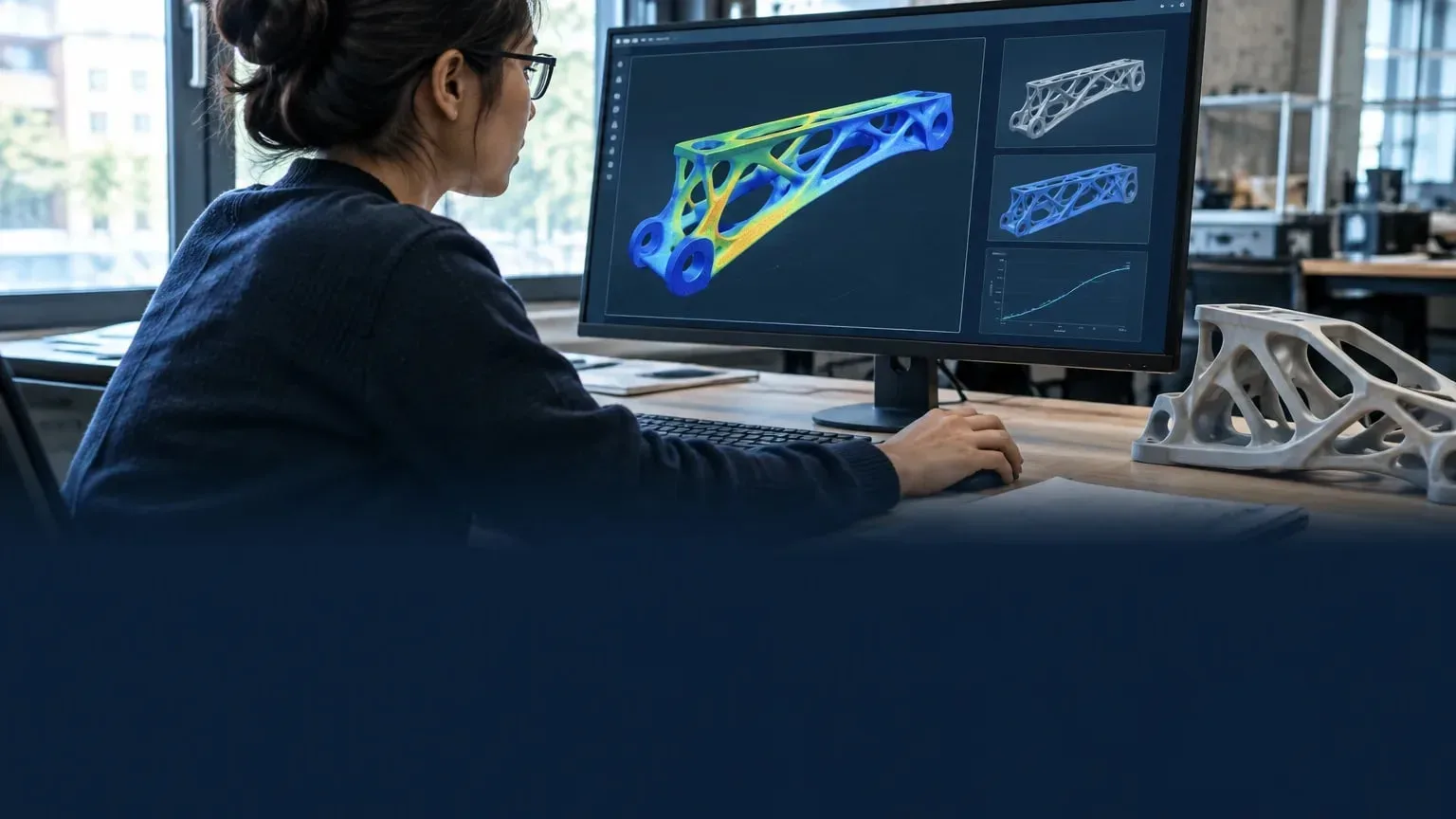
MIT researchers have developed an AI “copilot” for structural design that lets engineers intervene while topology optimization is still running, rather than waiting for a finished result. The team says the approach produced designs that were easier to manufacture and improved linear buckling load by 39 percent, while adding only about 15 seconds to total design time compared with all-algorithmic methods. The work matters because one of the main barriers to wider use of algorithmic structural design has been the lack of human control during the process.
Key facts
- The system adds human feedback during topology optimization instead of only showing a final design at the end.
- In demonstrations, the method improved manufacturability and linear buckling load by 39 percent.
- The added design time was about 15 seconds compared with all-algorithmic approaches.
- The researchers describe the work in an open-access paper published in Communications Engineering.
Why does this AI “copilot” matter for structural design?
It matters because topology optimization can generate high-performing designs, but engineers often see only the final output after a computationally intensive process. If the design includes impractical features or needs revision, the process may have to start over. MIT’s approach inserts human judgment during the design process, which the researchers say can improve trust, manufacturability, and structural performance without a large time penalty.
According to the researchers, topology optimization is already considered one of the most advanced algorithmic design techniques. It iteratively fills a design space to meet stated goals, but the resulting forms can be hard to build in practice. The MIT team highlights examples such as designs with eight or more beam connections at a single point, which may perform well in computation but be difficult to manufacture in the real world.
How the system changes the design process
The new system works by identifying regions of a developing design where a human engineer is likely to want changes. Rather than pausing the workflow for constant manual review, the researchers used machine learning to predict where feedback would be most useful.
To train that model, the team built a synthetic dataset representing probable human feedback across thousands of designs. The feedback covered areas including aesthetics, performance criteria, and manufacturability. During use, the system presents selected regions to the designer, who can currently make structures in those identified areas thicker or thinner.
The researchers frame that setup as a collaborative model rather than a replacement for human expertise. Their stated aim is to combine computational optimization with domain knowledge from practicing engineers as the design evolves.
What practical impact could this have for engineers, researchers, and students?
The clearest immediate impact is on people who use or study topology optimization. For engineers, the system is designed to address a common practical problem: algorithmic designs may be efficient on paper but difficult to trust or manufacture. By allowing intervention during the process, the approach could make it easier to shape a design before it reaches an unusable final form.
For researchers and students, the MIT team explicitly says it hopes the method will open topology optimization to a wider audience in both industry and academia. That matters because existing approaches can demand significant computation and can feel like a black box to users. A system that incorporates human input while keeping the time increase modest may be more approachable in teaching, experimentation, and design review settings.
- Who is affected: design engineers, researchers, and students working with structural optimization.
- What changes: users can provide feedback during optimization instead of only evaluating the end result.
- Current constraint: user edits are limited to making identified regions thicker or thinner.
- Likely next step: the researchers say they hope to add more modification options in future versions.
Why topology optimization has been hard to adopt more broadly
The researchers say the technique has gained traction in automotive and aerospace applications, but it has been used less for buildings and bridges. One reason is trust: design engineers need confidence that the output is not only structurally effective but also practical to make and acceptable to use.
Another issue is agency. In the conventional workflow described by the team, the human designer has little influence over how the form develops. That can make it harder to control undesirable features and may reduce a sense of ownership over the result. The MIT system is intended to change that balance by making the process more collaborative.
What comes next for the MIT approach?
For now, the interaction is limited. Users can adjust structures within identified regions by making them thicker or thinner. The researchers say they hope to expand the range of modifications in future versions.
The team also positions the method as complementary to fully AI-driven design approaches rather than a replacement for them. In settings with abundant computational resources, all-algorithmic workflows may still make sense. But where human judgment is essential, the collaborative method is intended to provide a practical alternative that keeps people involved in final design decisions.
The paper’s authors are Dat Ha, Ferdous Alam, Markus Buehler, Faez Ahmed, and senior author Josephine Carstensen. The work was supported in part by the MathWorks Engineering Fellowship Fund, TATA Steel, and the MIT Generative AI Impact Consortium.
FAQ
What improvement did the MIT AI design system show?
In demonstrations described by the researchers, the human-in-the-loop system improved manufacturability and linear buckling load by 39 percent while only modestly increasing total design time. The reported time increase compared with all-algorithmic approaches was about 15 seconds.
What can users change in the current version of the system?
At this stage, users can modify identified regions by making parts of the structure thicker or thinner. The researchers say they hope to add more options for modification in future versions.


