
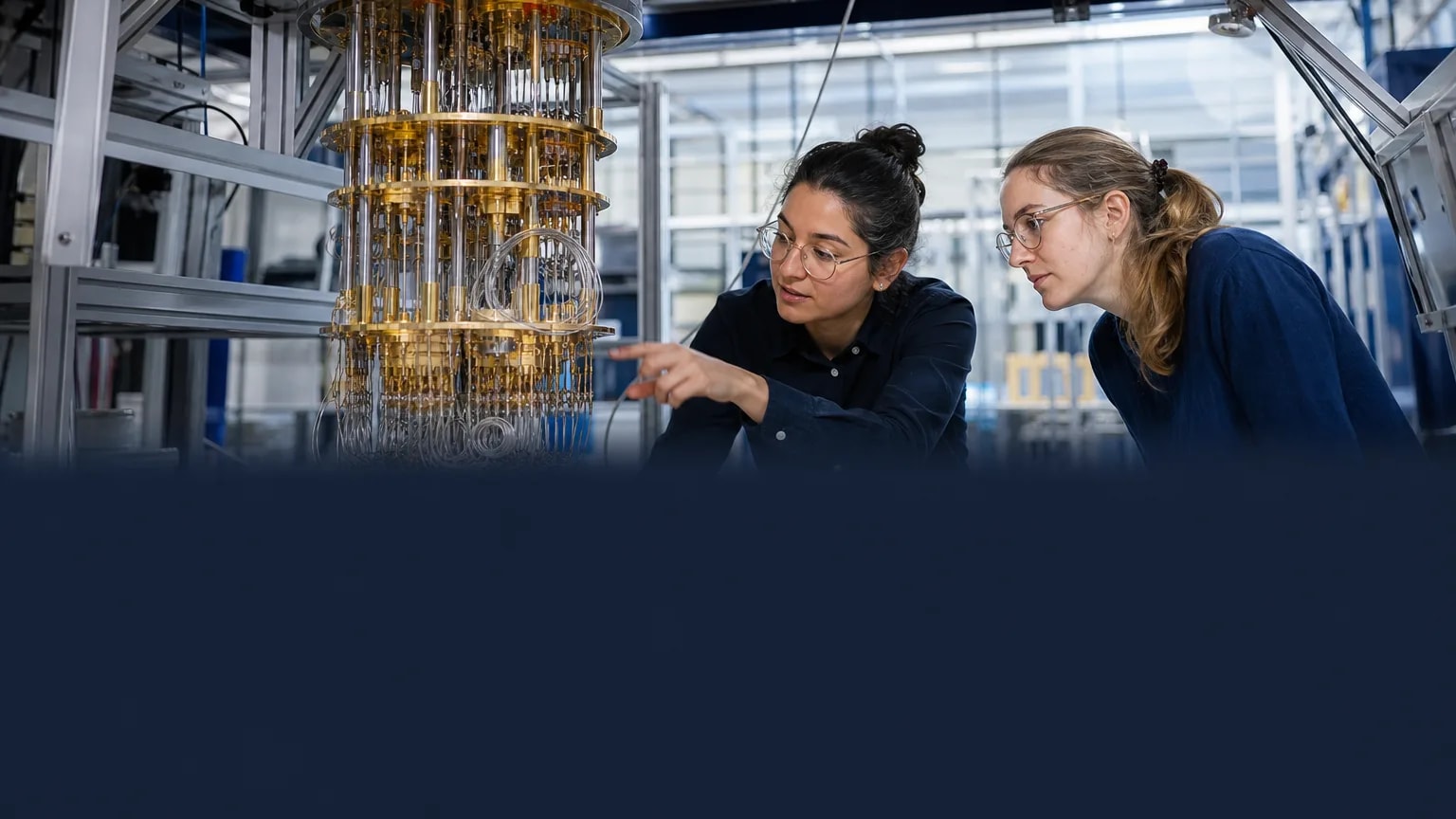
Yale is leading a five-year, $37.5 million National Science Foundation-backed effort to tackle quantum error correction, a central barrier to reliable quantum computing. The new NSF Quantum Leap Challenge Institute for Physics and Engineering of Practical Quantum Error Correction, known as NSF PRACTIQAL, brings together researchers across disciplines and universities to develop a path toward practical, industry-scale quantum computers. The work matters because quantum machines must identify and correct errors faster than they occur to become reliable enough for real-world use. .
Key facts
- The NSF grant totals $37.5 million and supports a five-year project led by Yale.
- NSF PRACTIQAL will address quantum error correction from physical qubits and control electronics through to algorithms.
- The center will focus on scaling error-corrected machines and on “erasure qubits,” designed to signal where and when an error occurred.
- The award is one of eight NSF Quantum Leap Challenge Institute grants for large-scale interdisciplinary research centers.
What this means for researchers and universities
For researchers and participating universities, NSF PRACTIQAL creates a coordinated program spanning physics, engineering, computer science and chemistry. Rather than treating hardware, error-correction codes and algorithms as separate problems, the center aims to optimize them together, with the goal of making fault-tolerant quantum systems more achievable, efficient and practical.
Yale faculty involved include Robert Schoelkopf and Michael Hatridge, along with Yongshan Ding, Lin Zhong, Aleksander Kubica, Shruti Puri, Steven Girvin, Konrad Lehnert and Victor Batista. The institute also includes partner universities, industrial partners and an external advisory board intended to help keep its research relevant to the broader quantum-computing community.
Why is quantum error correction the project’s central challenge?
Quantum error correction is central because qubits are fragile: noise and other environmental factors can disrupt their quantum states. A practical machine therefore needs to detect and correct errors faster than those errors arise. NSF PRACTIQAL is designed to investigate the science and engineering needed to make that process more efficient and workable in larger systems.
Conventional computing information is represented by robust ones and zeros, while qubits are substantially more susceptible to error. That difference has made reliability a major obstacle for quantum computing, despite its potential to address problems that are nearly impossible for classical computers, including possible applications in materials science and drug design.
“Today, error correction is the main scientific and engineering challenge for making quantum computing useful,” said Robert Schoelkopf, the center’s director and Sterling Professor of Applied Physics.
How NSF PRACTIQAL plans to connect the quantum computing stack
The center’s approach is to work across every level of a quantum computer. Its researchers will study physical qubits and control electronics as well as the codes and algorithms used to operate a machine. The aim is to ensure that hardware and software are designed to run compatible types of code, improving efficiency and reducing susceptibility to errors.
One research priority is identifying the issues that have slowed the scaling of error-corrected machines. A second is exploring erasure qubits, which were pioneered by members of the PRACTIQAL team. These specially designed qubits act as flags that identify the location and timing of an error, an approach the institute will examine as part of making error correction more practical.
Michael Hatridge, PRACTIQAL’s co-director and an associate professor of applied physics, said much prior work has focused on very small machines optimized for error correction. The group’s objective is to shorten the route to large-scale, error-corrected quantum computers by proving ideas and laying out a pathway for bigger systems rather than building a giant system itself.
What the five-year effort is intended to deliver
By the end of the five-year project, the researchers expect to have developed a path toward practical error-correcting computers on an industrial scale. The institute’s role is to coordinate expertise that is often concentrated on individual components and apply it to an optimized whole-machine design.
The NSF grant is one of eight awards for Quantum Leap Challenge Institutes, which are large-scale interdisciplinary centers addressing major challenges in quantum information science and technology. For Yale and its collaborators, the grant supports an effort to connect foundational research on errors in quantum devices with the hardware and software choices needed for reliable machines.
Frequently asked questions
What is NSF PRACTIQAL?
NSF PRACTIQAL is the NSF Quantum Leap Challenge Institute for Physics and Engineering of Practical Quantum Error Correction. Led by Yale, it is a five-year, $37.5 million center bringing together computer scientists, chemists, physicists and engineers to advance large-scale, error-corrected quantum computing.
What are erasure qubits?
Erasure qubits are specially designed qubits that signal exactly where and when an error has occurred. NSF PRACTIQAL will explore their use as part of its work to make quantum error correction more practical and efficient.


